
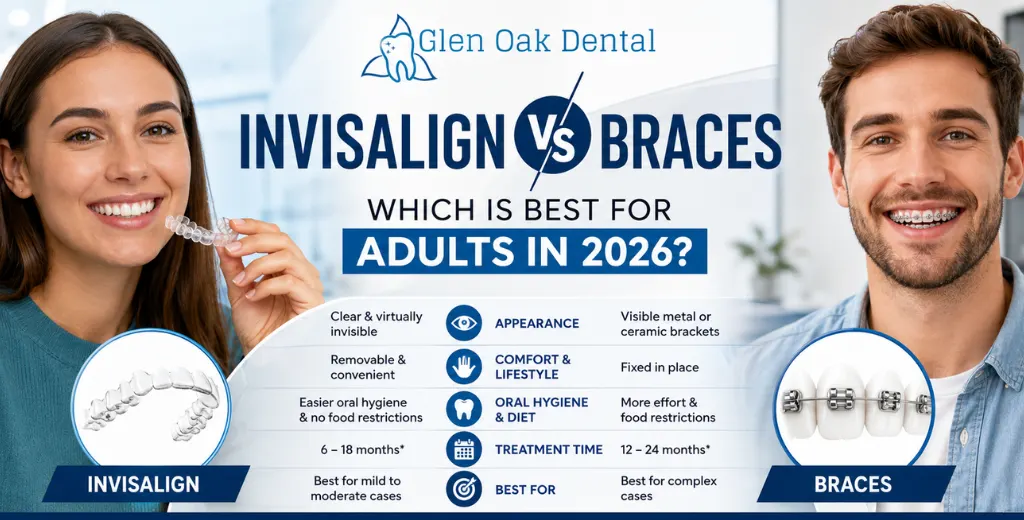
Invisalign uses clear, removable aligners — ideal for adults who want a discreet, flexible orthodontic option. Traditional braces use fixed metal or ceramic brackets and suit complex dental issues that require precise tooth movement. At Glen Oak Dental in North York, we assess your bite, alignment, and lifestyle to recommend the right treatment — not the trending one. Ultimately, the best choice depends on your specific clinical needs, not assumptions.
Invisalign vs Braces: Which Is Best for Adults in 2026?
If you are searching for Invisalign vs braces, you are likely at a decision point — wanting straighter teeth but unsure which treatment fits your lifestyle, budget, and long-term goals. As a dental team, we guide adult patients through this exact choice every day at our North York orthodontics and Invisalign clinic.
The right option depends on more than just appearance. In fact, it comes down to how your teeth move, how committed you can be to treatment, and what kind of results you need.
Why the Right Choice Matters
Both Invisalign and braces are clinically proven orthodontic treatments — however, each performs best in specific situations. For instance, Invisalign excels for adults with mild to moderate alignment concerns, while braces remain the stronger choice for complex bite corrections. As a result, choosing without proper clinical assessment can lead to longer treatment times and less predictable outcomes. Let us break it down clearly so you can decide with confidence.
What Is Invisalign?
Invisalign is a modern orthodontic solution that uses clear, removable aligners to gradually shift teeth into alignment. Furthermore, it has become especially popular among adults who want flexibility without compromising their professional appearance.
How Does Invisalign Work?
The treatment process at Glen Oak Dental’s Invisalign clinic in North York follows a clear, step-by-step approach:
- We start with a digital scan of your teeth
- Next, our team creates a custom treatment plan based on your specific alignment needs
- You then receive a series of custom-made clear aligners
- Each aligner works for 1–2 weeks before you advance to the next set
- As a result, your teeth gradually shift into the desired position over the treatment period
Why Consistency Is Critical with Invisalign
Most patients wear aligners for 20–22 hours per day. This consistency is, above all, the key to achieving the best results with Invisalign clear aligners. In addition, patients who follow their wear schedule closely tend to finish treatment faster and with fewer complications. Consequently, Invisalign suits adults especially well because it is discreet, removable, and fits seamlessly into a busy professional lifestyle.
What Are Traditional Dental Braces?
When comparing dental braces vs Invisalign, braces remain a highly effective, time-tested orthodontic solution with a proven clinical track record spanning decades.
How Do Braces Work?
Traditional braces rely on three core components:
- Metal or ceramic brackets that bond directly to the teeth
- Wires that apply continuous, controlled pressure to guide tooth movement
- Periodic adjustments that your dentist or orthodontist carries out throughout treatment
When Are Braces the Stronger Choice?
Unlike Invisalign, braces stay fixed — meaning they work continuously, with no reminders or daily discipline needed. Moreover, for complex cases involving severe crowding, bite correction, or jaw alignment, braces deliver more precise control over tooth movement. As a result, they remain the gold standard for patients with significant orthodontic needs. Our dental team in North York evaluates every patient individually before making any orthodontic recommendation.
Invisalign vs Braces Cost in Canada
One of the most common concerns patients bring to their Invisalign consultation is cost. Understanding the true Invisalign vs braces cost helps you plan your treatment without surprises.
How Much Is Invisalign in Canada?
Invisalign aligners price: $5,000 – $8,500 (depending on case complexity and treatment duration)
How Much Do Braces Cost in Canada?
Braces cost in Canada: $3,500 – $7,500
Related Cost Questions We Hear Often
- How much are teeth braces? — The price depends on case complexity, treatment length, and the type of brackets your dentist selects
- How much do braces cost in Canada with insurance? — Most dental insurance plans partially cover orthodontic treatment
- How much are braces in Ontario without insurance? — Typically around $4,000–$7,500 depending on the clinic and case
What Affects the Final Price?
In summary, the final price for both Invisalign and braces depends on case complexity, treatment duration, and the technology the clinic uses. Furthermore, at Glen Oak Dental, flexible payment options and direct insurance billing make orthodontic treatment more manageable for our patients. Therefore, we always recommend getting a full cost breakdown during your consultation before you commit to any treatment.
Invisalign vs Braces: Quick Comparison Table
Here is a clear side-by-side view of braces vs Invisalign across the factors that matter most to adult patients. Use this table to quickly identify which option aligns with your priorities before your consultation.
| Feature | Invisalign | Traditional Braces |
|---|---|---|
| Appearance | Nearly invisible clear aligners | Visible metal or ceramic brackets |
| Removability | Fully removable | Fixed — stays on throughout treatment |
| Comfort | Smooth plastic — gentle on gums | Can irritate gums and cheeks initially |
| Eating | No food restrictions — remove aligners | Food limitations — avoid hard/sticky foods |
| Oral Hygiene | Easy — brush and floss normally | Requires extra effort around brackets |
| Treatment Time | 6–18 months (with proper wear) | 12–24 months |
| Effectiveness | Mild to moderate cases | Mild to complex cases — full range |
| Discipline Required | High — must wear 20–22 hrs/day | Low — always in place |
Invisalign vs Braces: Pros & Cons Breakdown
Beyond the comparison table above, it helps to understand specific trade-offs for each option. The following breakdown shows where each treatment excels and where it falls short.
Invisalign: Key Pros and Cons
| Category | Pros | Cons |
|---|---|---|
| Appearance | Nearly invisible throughout treatment | Slight visibility up close |
| Comfort | Smooth plastic — no irritation | Pressure when switching to new trays |
| Flexibility | Fully removable for events and meals | Requires strong daily discipline |
| Eating | No food restrictions at all | Must remove aligners before eating |
| Hygiene | Easy cleaning routine | Consistency is essential |
| Effectiveness | Great for mild to moderate cases | Less effective for complex cases |
Traditional Braces: Key Pros and Cons
| Category | Pros | Cons |
|---|---|---|
| Appearance | Reliable, predictable results | Noticeable brackets and wires |
| Strength | Handles complex correction well | Initial gum irritation possible |
| Flexibility | Always working — no effort needed | Less flexibility in daily lifestyle |
| Eating | No removal needed at meals | Avoid hard and sticky foods |
| Hygiene | Fixed system — consistent wear | Harder to clean around brackets |
| Effectiveness | Handles all case complexities | More invasive feel than aligners |
Benefits of Invisalign for Adults
Many patients researching Invisalign for adults want the convenience of a modern orthodontic solution without sacrificing clinical results. Notably, Invisalign at Glen Oak Dental offers several meaningful advantages over traditional braces for adult patients.
Benefits of Invisalign Over Braces
- Discreet appearance: Clear aligners stay nearly invisible — as a result, they suit professionals and business owners especially well
- Removable design: Take them out for meals, sports, special occasions, or important presentations
- No dietary restrictions: Eat whatever you like — simply remove aligners first and replace them after
- Easier oral hygiene: Brush and floss normally without navigating around wires and brackets
- Fewer clinic visits: You need fewer adjustment appointments compared to traditional braces
- Comfortable fit: Smooth plastic edges eliminate cheek or gum irritation from metal components
Who Benefits Most from Invisalign?
In particular, this combination makes Invisalign ideal for professionals, business owners, students, and anyone who values aesthetics and flexibility during their orthodontic journey. Additionally, pairing your Invisalign treatment with our professional teeth cleaning services in North York helps keep your smile healthy and your aligners fitting correctly throughout treatment.
Benefits of Braces Over Invisalign
Despite the growing popularity of clear aligners, there are clear clinical situations where traditional dental braces remain the superior choice — particularly for complex orthodontic cases.
Why Choose Traditional Braces
- Better for complex dental issues: Severe crowding, significant bite problems, and jaw alignment cases respond better to braces
- No discipline required: Braces stay fixed — therefore, they carry no risk of under-wearing and no delays to results
- More precise tooth movement control: Dentists gain greater control over individual tooth positioning through brackets and wires
- Proven results over decades: A time-tested orthodontic solution that extensive clinical evidence supports
- Often lower initial cost: Braces typically cost less than Invisalign for equivalent complexity
Is Braces the Right Choice for Your Case?
For severe alignment or bite issues, braces are often the better clinical choice. Nevertheless, the only way to know for certain is through a professional assessment. Our team will consequently explain exactly which treatment fits your individual situation during your initial consultation.
Which Is Faster: Invisalign or Braces?
Patients often ask: Is Invisalign faster than braces? The answer depends on two things — the complexity of your case and how consistently you wear your aligners.
Treatment Timeline Comparison
- Invisalign treatment time: 6–18 months for mild to moderate cases
- Traditional braces treatment time: 12–24 months, especially for complex cases
The Key Factor: Compliance
Invisalign can indeed be faster — but only when patients wear it properly. If aligners do not get their required 20–22 hours per day, treatment will consequently take significantly longer than projected. Braces, on the other hand, stay fixed and work consistently without any patient effort. Our Invisalign team at Glen Oak Dental provides a realistic timeline estimate after reviewing your digital scan and bite analysis.
Can Invisalign Fix Underbite and Other Bite Issues?
A common question is: Can Invisalign fix underbite? The answer depends on the severity of the misalignment. Invisalign effectively treats mild to moderate bite corrections, while more severe cases often require traditional braces or combined orthodontic treatments.
What Invisalign Can Treat
- Mild to moderate underbite
- Overbite correction
- Crossbite alignment
- Gaps between teeth (diastema)
- Mild to moderate crowding
When Braces Are the Better Choice
- Severe bite problems that require significant jaw repositioning
- Jaw alignment issues that may also require surgical consultation
- Complex multi-tooth movement cases
What Happens in Advanced Cases?
In advanced cases, dentists often use additional treatments — such as elastics, expanders, or surgical orthodontics — alongside either Invisalign or braces. Furthermore, our team will refer you appropriately if your case requires specialist collaboration. As a result, you can trust that your treatment plan remains clinically sound from the very start.
Real-World Decision: How Adults Choose Between Invisalign and Braces
When comparing braces vs Invisalign, most adults focus on three key factors that directly affect their daily life during treatment.
1. Lifestyle
First and foremost, if you want flexibility, a natural look during treatment, and the ability to remove your orthodontic appliance for important moments — Invisalign is likely the right choice for you.
2. Discipline
On the other hand, if you prefer a “set it and forget it” approach where results do not depend on your daily compliance — Braces ensure consistent treatment progress without requiring daily effort.
3. Complexity of Your Case
Finally, if your case involves significant bite issues, severe crowding, or complex tooth movement beyond mild to moderate alignment — Braces typically offer more precise clinical control and better long-term results.
In all cases, at Glen Oak Dental’s cosmetic dentistry team in North York, we assess all three of these factors during your consultation and therefore help you choose with full confidence.
Invisalign Consultation and Pricing: What to Expect at Glen Oak Dental
If you are searching for an Invisalign consultation or Invisalign services near me in North York, here is exactly what happens at your first visit to Glen Oak Dental.
During Your Invisalign Consultation Visit
- Our team performs a digital scan of your teeth using intraoral scanner technology
- We conduct a full bite analysis and alignment assessment
- You receive a customised treatment plan specific to your clinical needs
- We provide a detailed cost and timeline breakdown with no surprises
- You get a preview of your projected results — so you can see your new smile before committing
Insurance, Coordination, and Next Steps
In addition, we review your insurance coverage upfront and direct bill most major Canadian providers including Sun Life, Manulife, Great-West Life, and Equitable Life. Moreover, for patients who need other dental work alongside orthodontic treatment, our team coordinates root canal treatment, dental bridges, or teeth whitening in North York to complete your full smile transformation.
What the ADA, CDA, and Health Canada Say About Orthodontic Treatment
All three major dental and health authorities provide consistent guidance on orthodontic treatment options and when each approach suits adult patients most appropriately.
American Dental Association — Evidence-Based Orthodontic Guidelines
The American Dental Association (ADA) recognises both Invisalign and traditional braces as clinically validated orthodontic treatments. Furthermore, the ADA stresses that clinical evidence must drive treatment selection — X-rays, examination findings, bite analysis, and the patient’s individual health picture — rather than patient preference alone. As a result, both clear aligner therapy and fixed appliance treatment show strong evidence when clinicians apply them to appropriate case types.
Canadian Dental Association — Patient-Centred Orthodontic Care
Similarly, the Canadian Dental Association (CDA) supports individualised care for orthodontic patients. The CDA recognises that the same misalignment may call for different management depending on the patient’s age, bite complexity, personal goals, and overall oral health status. Consequently, all orthodontic treatment at Glen Oak Dental follows CDA clinical guidelines, and our team encourages patients to ask questions until they feel fully confident in their recommended plan.
Health Canada — Oral Health and Orthodontic Access
In addition, Health Canada recognises oral health — including proper dental alignment — as an important component of overall wellbeing. Misaligned teeth can contribute to uneven wear, jaw discomfort, difficulty cleaning, and long-term gum disease risk. Therefore, Health Canada’s expanding dental benefit programs reflect a commitment to making dental care, including orthodontic treatment, more accessible to eligible Canadians. As a next step, patients should check whether their family qualifies under the Canada Dental Plan for partial orthodontic coverage.
Invisalign vs Braces: Final Decision Guide
If you are deciding between Invisalign vs braces and want to find the best overall fit for your life, use this simple clinical framework to guide your decision.
Choose Invisalign If:
- You want a discreet orthodontic option that fits your professional or social lifestyle
- You can commit to wearing aligners for 20–22 hours per day consistently
- Your case involves mild to moderate alignment corrections, gaps, or crowding
- You value the flexibility to remove your aligner for meals, sports, and important events
Choose Braces If:
- You need correction for complex bite or alignment issues beyond what clear aligners can manage
- You want a fixed solution that does not rely on daily patient compliance to work
- You prefer predictable, hands-off treatment with fewer decisions to make day-to-day
- You are looking for a potentially lower starting cost for your orthodontic investment
The Bottom Line
Ultimately, when it comes to Invisalign vs braces, the best choice depends on your clinical needs — not trends. However, if you are still unsure after reviewing both options, the most important next step is a professional consultation with an experienced dental team who can assess your specific situation in person.
Frequently Asked Questions: Invisalign vs Braces
This article draws on clinical dental guidelines and real-world orthodontic experience at Glen Oak Dental in North York, Ontario. We reviewed it using trusted sources including the American Dental Association (ADA), the Canadian Dental Association (CDA), and Health Canada. The content follows current SEO and AI optimisation practices to ensure accuracy, clinical reliability, and genuine value for patients seeking orthodontic information.
Ready to Start Your Invisalign or Braces Journey in North York?
Glen Oak Dental — 2827 Bathurst Street, North York, ON M6B 3A4
Phone: 416-551-8480 | glenoakdental.ca
Led by Dr. Roya Khoshsar, D.D.S. — 15+ years of clinical experience in North York
Same-day emergency appointments available | Accepting new patients of all ages | Direct insurance billing
Whether you want to understand your Invisalign vs braces cost, explore Invisalign clear aligners, or discuss cosmetic dentistry options to complete your smile — our team delivers a full clinical assessment and honest guidance at every step. You can also explore teeth whitening in North York or dental implants to complete your overall treatment plan.