
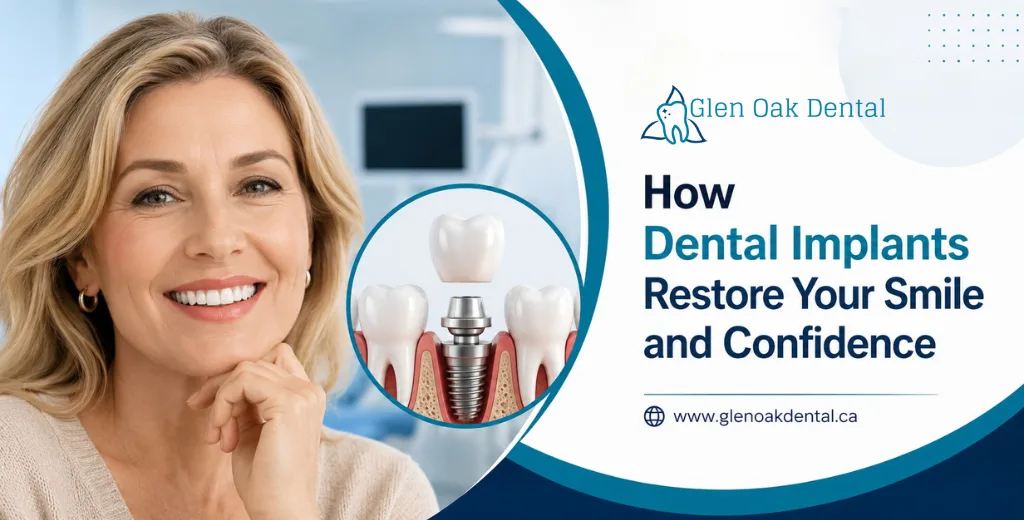
Dental implants are titanium posts surgically anchored into your jawbone that replace both the root and crown of a missing tooth, restoring up to 90% of your natural bite force and preventing the bone loss that comes with tooth loss. At Glen Oak Dental, we help patients in North York restore their smile, health, and confidence with modern implant dentistry.
Dental Implants: The Complete Guide
Losing a tooth—whether to an unexpected injury, a cracked root, or decay that got out of hand—is never just a physical problem. It changes how you speak, how you chew, and how often you laugh without reflexively covering your mouth.
Dental implants are titanium posts surgically anchored into the jawbone that replace both the root and crown of a missing tooth, restoring function and confidence.
I see this every week in my clinic. A patient sits in the chair, covers their mouth while talking, and admits they haven’t ordered a steak or crisp apple in years. Missing teeth alter the shape of your face and erode your self-esteem bit by bit.
If you are researching how dental implants restore both function and self-assurance, you are asking the right questions at the right time. Modern dental technology has transformed implant treatment from a complex ordeal into a routine, highly predictable restoration.
In this complete guide, I will walk you through how dental implants work, why they outperform traditional alternatives, and how they protect your long-term oral health.
What Are Dental Implants? (The Anatomy of a New Tooth)
A dental implant consists of a titanium post that acts as an artificial root, an abutment connector, and a custom ceramic crown that replaces the entire structure of a missing tooth, root included.
To understand why dental implants feel and function like natural teeth, it helps to look below the gumline. A natural tooth has two main parts: the crown (the visible white part above the gums) and the root (the invisible anchor buried in your jawbone).
Traditional bridges and dentures only replace the crown. An implant replaces the entire structure, root included.
An implant system consists of three distinct parts:
- The Titanium Post: A small, biocompatible screw placed directly into your jawbone. It acts as an artificial root.
- The Abutment: A tiny connector piece that sits on top of the post, sticking out slightly past the gumline to hold your new crown.
- The Custom Crown: The visible, handcrafted ceramic tooth shaped and shaded to match your surrounding natural teeth perfectly.
       [ Custom Crown ]      <- Visible ceramic tooth (matches natural teeth)
              ||
         [ Abutment ]        <- Connector piece above gumline
              ||
    === [ Titanium Post ] ===  <- Embedded artificial root inside jawbone
Because titanium is biocompatible, your body does not reject it. Instead, a natural process called osseointegration takes place. Over a few months, your jawbone grows directly around the post, anchoring it into your jaw just like a natural root.
How Dental Implants Restore Your Smile, Health, and Confidence
Dental implants stop premature bone loss, restore up to 90% of natural bite force, protect adjacent teeth, and eliminate the speech impairments and slippage common with dentures.
Replacing a tooth is not merely cosmetic. While a complete, bright smile looks wonderful, the underlying structural benefits of implants are what make them the gold standard in modern dentistry.
1. Stopping Premature Bone Loss
When you lose a tooth, your jawbone loses the daily stimulation it used to get from chewing forces. Without that pressure, your body begins to reabsorb the bone tissue. In the first year alone after losing a tooth, you can lose up to 25% of the bone density in that area.
As jawbone shrinks, the facial structure collapses inward. Lips lose support, cheeks sink, and fine lines around the mouth deepen. Because dental implants fuse directly with the jawbone, they transfer bite forces into the bone, stimulating it and preventing future bone loss entirely.
2. Restoring Full Bite Force
Removable dentures restore roughly 20% to 30% of your original chewing power. Try biting into an ear of corn or a raw carrot with removable dentures, and you will quickly see the limitation.
Because dental implants anchor straight into the jawbone, they restore up to 90% or more of your natural bite force. You can return to eating the foods you love without worrying about slip-ups, pain, or embarrassing shifts.
3. Protecting Your Adjacent Natural Teeth
With a traditional dental bridge, the teeth on either side of the gap must be shaved down and fitted with crowns to hold the replacement tooth in place. You essentially sacrifice two healthy teeth to replace one missing tooth.
Dental implants are standalone restorations. They do not rely on adjacent teeth for support, leaving your remaining natural teeth intact and untouched.
4. Eliminating Speech Impairments and Slippage
Loose dentures can slip when you talk, speak quickly, or laugh hard. This often causes slurring or clicking sounds, leading to social anxiety. Implants remain firmly fixed in place. They allow you to speak naturally, clearly, and without a second thought.
Comparing Your Options: Implants vs. Bridges vs. Dentures
Dental implants restore over 90% of bite force and can last a lifetime, while traditional bridges restore 50-70% and last 7-15 years, and removable dentures restore only 20-30% and last 5-8 years.
When patients ask me about their options, we weigh durability, comfort, maintenance, and long-term costs. Here is how the three main tooth replacement choices stack up side-by-side:
| Feature | Dental Implants | Traditional Dental Bridge | Removable Dentures |
|---|---|---|---|
| Lifespan | 25+ years to life | 7–15 years | 5–8 years |
| Bite Force Restored | 90%+ | 50%–70% | 20%–30% |
| Bone Preservation | Prevents jawbone loss | Bone loss continues | Bone loss accelerates |
| Impact on Other Teeth | None | Requires shaving neighboring teeth | Clasp pressure can loosen neighboring teeth |
| Daily Care | Standard brushing & flossing | Special threaders needed under bridge | Soaking, adhesives, messy cleanup |
While dental implants carry a higher initial investment, their long lifespan and high success rate make them the most cost-effective option over a lifetime.
The Dental Implant Process: Step-by-Step
The dental implant process involves a 3D CBCT consultation, optional bone grafting, implant placement surgery, three to six months of osseointegration healing, and finally attaching the abutment and permanent crown.
Patients often assume getting a dental implant is painful or overly complicated. In reality, with precise digital planning and modern local anaesthesia, most of my patients report that the procedure is far easier than they expected—often with less discomfort than a standard tooth extraction.
Here is what the journey looks like from start to finish:
Step 1: Initial Comprehensive Consultation
We begin with digital 3D CBCT scans. These detailed images allow us to map your bone density, nerve pathways, and sinus locations in three dimensions. We verify that you have enough healthy bone to support an implant and design a precise surgical guide before we even start.
Step 2: Site Preparation (If Required)
If you have been missing a tooth for a long time, the jawbone in that area may have thinned out. If so, a minor procedure called a bone graft rebuilds the necessary bone depth. Healing from a graft takes anywhere from two to four months before the implant can be placed safely.
Step 3: Implant Placement
During this short minor surgery, we numb the area completely with local anaesthesia. We make a small incision in the gum, prepare the bone channel, and place the titanium implant post. You will feel light pressure, but no pain. We then close the gum tissue with tiny dissolvable sutures.
Step 4: Osseointegration and Healing
Over the next 3 to 6 months, the magic happens under the surface. Your natural bone tissue grows into the textured surface of the titanium post. During this healing period, we can provide a temporary tooth so you never have to walk around with a visible gap.
Step 5: Placing the Abutment and Crown
Once the implant has fused solidly with your bone, we uncover it, attach the custom abutment, and take a final digital impression. A few weeks later, we secure your permanent porcelain crown. You leave the office with a fully functional, natural-looking tooth.
Am I a Candidate for Dental Implants?
Most healthy adults with adequate bone density, healthy gums, and no uncontrolled systemic conditions are candidates for dental implants, regardless of age.
Most adults in good general health are candidates for implants. However, successful outcomes rely on a few crucial factors:
- Adequate Bone Density: You need enough healthy jawbone to anchor the titanium post. If you lack bone height or width, a bone graft can usually resolve this issue.
- Healthy Gums: Active periodontal (gum) disease can interfere with healing and cause implant failure. Any gum infections must be treated and controlled first.
- Good Overall Health: Conditions like uncontrolled diabetes or autoimmune disorders can slow healing. We carefully review your complete medical history to ensure placement is safe.
- Non-Smoker Status: Smoking reduces blood flow to oral tissues, significantly increasing the risk of implant failure during the healing phase. We strongly advise patients to quit or pause smoking before treatment.
Age alone is rarely a limiting factor. Whether you are 25 or 85, as long as your jaw has finished growing and your body heals normally, you can safely receive dental implants.
How to Care for Your Dental Implants
Caring for a dental implant is identical to caring for a natural tooth: brush twice daily, floss around the crown daily, and attend biannual professional cleanings.
One of the greatest advantages of a dental implant is how simple it is to maintain. Unlike removable dentures that require special cleansers or pastes, caring for an implant is identical to caring for your natural teeth.
- Brush Twice Daily: Use a soft-bristled toothbrush and a non-abrasive fluoride toothpaste.
- Floss Daily: Clean around the implant crown daily. Water flossers or specialized implant floss work exceptionally well.
- Keep Regular Cleanings: Visit your dental team every six months for professional check-ups and cleanings. We use specialized instruments designed for titanium components to clean around your restoration safely.
- Avoid Harsh Habits: Never use your teeth as tools to open plastic packaging, chew ice, or bite down on hard objects like unpopped popcorn kernels.
While an artificial crown cannot develop a cavity, the surrounding gums can still become inflamed if plaque builds up. Good oral hygiene prevents peri-implantitis—an inflammatory condition similar to gum disease that can compromise the bone supporting your implant.
Comprehensive Care at Glen Oak Dental
At Glen Oak Dental, we view tooth replacement as a transformational step toward better overall health and confidence. Every mouth is unique, which is why we rely on advanced digital imaging and gentle, patient-centered techniques to plan every procedure down to the millimeter.
From your initial 3D scan to the moment you see your completed restoration in the mirror, our goal is to keep you comfortable, informed, and completely confident in your care.
Frequently Asked Questions
Complete Dental Care: Related Services at Glen Oak Dental
Dental implants often overlap with other treatments as part of a complete tooth-replacement plan. At Glen Oak Dental, we also provide:
- Dental implants in North York — for permanently replacing missing teeth and preserving jawbone health.
- Dentures in North York — for patients needing a full or partial removable tooth replacement.
- Dental bridges in North York — a fixed, non-surgical alternative for replacing one or more consecutive missing teeth.
- Tooth extraction in North York — safe, gentle extractions with replacement planning discussed at your follow-up.
- Teeth cleaning in North York — regular professional cleanings that protect your implants and remaining natural teeth.
- Emergency dentistry in North York — for sudden pain, a broken tooth, or a lost crown.
Taking the Next Step Toward Your New Smile
Deciding to move forward with dental implants is a significant step, but it is also a highly exciting one. By researching your options, you are actively choosing to reclaim your daily comfort, your oral health, and your confidence to smile freely.
You do not have to make this monumental choice alone. The absolute best way to find out if dental implants are right for your unique anatomy is to undergo a comprehensive clinical examination. Here at Glen Oak Dental, we will take detailed 3D CBCT scans of your jawbone, carefully discuss your long-term lifestyle goals, and build a highly personalized treatment plan that perfectly fits your clinical needs.
Do not let missing teeth hold you back from enjoying your life any longer. Reach out to schedule a consultation, and let’s get you back to smiling, speaking, and eating with total confidence.
Book Your Consultation in North York
Glen Oak Dental — 2827 Bathurst Street, North York, ON M6B 3A4
Phone: 416-551-8480 | glenoakdental.ca
Led by Dr. Roya Khoshsar, D.D.S. — 15+ years of clinical experience in North York
Dental implants and restorative dentistry under one roof | Accepting new patients of all ages | Direct insurance billing
To ensure this guide provides safe, reliable, and clinically accurate guidance, the content was developed using the following standards: Clinical Guidelines: This article follows clinical standards established by the Canadian Dental Association (CDA), the American Dental Association (ADA), and Health Canada. Medical Verification: Facts regarding jawbone resorption, osseointegration, and success rates were cross-referenced with peer-reviewed dental literature and clinical practice consensus. Optimization Standards: Written following best practices for Search Engine Optimization (SEO), Answer Engine Optimization (AEO), and Generative Engine Optimization (GEO) to provide direct, clear, and reliable answers for patients and search engines alike.