
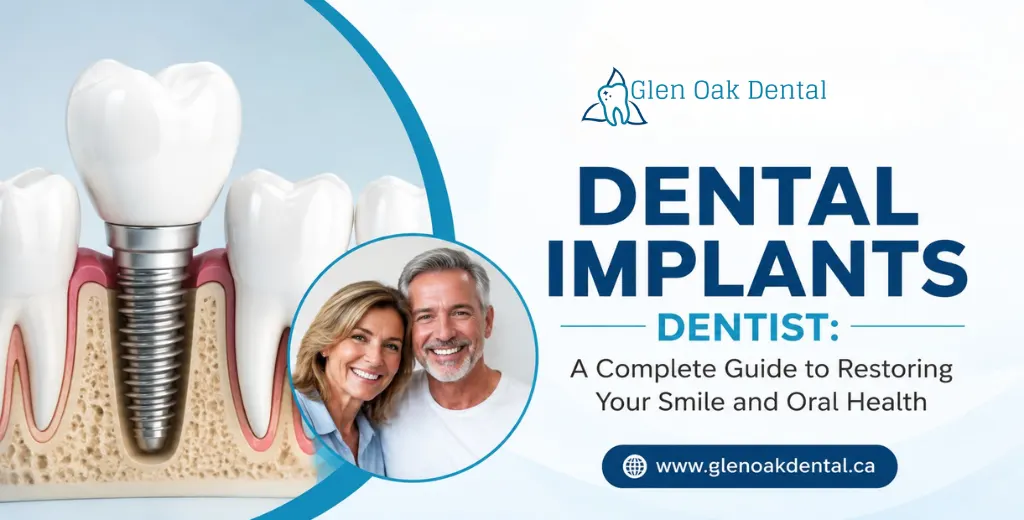
A dental implant is a small, high-tech titanium post placed directly into your jawbone that acts as the root of a natural tooth, giving you a strong, stable foundation for permanent or removable replacement teeth. At Glen Oak Dental, we help patients restore their smile, oral health, and confidence with modern dental implants.
Dental Implants: The Complete Guide
Hello there. If you are reading this, chances are you or a loved one are missing a tooth—or perhaps several teeth—and you are looking for real, honest answers. I completely understand. Losing a tooth can feel overwhelming. It changes how you chew your favourite foods, alters the way you speak, and can even make you hesitate before flashing a smile in photos.
As a dentist, I see this every single day. Patients sit in my chair feeling self-conscious and worried about their options. I always tell them the same thing: modern dentistry has given us an incredible solution. Dental implants are the closest thing we have to giving you back your natural teeth.
But navigating the world of tooth replacement can feel like learning a new language. You might be wondering who does dental implants, how the process works, and what you should look for in a dental implants dentist.
I wrote this guide to cut through the clinical jargon. No confusing terms, no fear tactics—just a clear, straightforward roadmap to restoring your smile, your oral health, and your confidence, backed by science and actual clinical practice.
What Exactly is a Dental Implant?
Before we talk about finding the right professional, we need to understand the technology.
A dental implant is a small, high-tech titanium post. I place this post directly into your jawbone beneath your gums. Once healed, it acts exactly like the root of a natural tooth. This is a crucial distinction. While traditional dentures or bridges only replace the visible part of your tooth, an implant replaces the entire tooth structure from the root up.
The Anatomy of a New Smile
An implant system actually consists of three distinct parts:
- The Implant (The Root): The titanium screw that integrates safely with your natural bone.
- The Abutment (The Connector): A small piece that attaches to the top of the implant, sitting just above the gumline.
- The Crown (The Tooth): The custom-made, colour-matched ceramic or porcelain tooth that I attach to the abutment.
Because we use biocompatible materials (like titanium), your body accepts the implant as part of itself. It is a brilliant piece of biological engineering.
Who Does Dental Implants?
This is one of the most common questions I hear. If you are starting your research, you might be typing phrases into Google like who can do dental implants or what dental specialty does implants. Let me clarify the landscape for you.
Legally and clinically, several types of dental professionals can place implants. The key difference lies in their specific training and focus.
General Dentists with Advanced Training
Many general dentists pursue extensive postgraduate training to become a dedicated dental implant dentist. They take comprehensive courses, perform guided surgeries, and dedicate a large portion of their practice to implantology. If your regular dentist has this specific training, they can often manage your entire treatment from start to finish.
Periodontists
A periodontist specializes in the gums and the bone supporting the teeth. Because successful implant placement relies heavily on healthy bone and tissue, periodontists naturally perform many implant surgeries.
Oral and Maxillofacial Surgeons
Oral surgeons specialize in complex surgical procedures of the mouth, jaw, and face. If a patient requires extensive bone grafting, sinus lifts, or has a highly complex medical history, I often collaborate with an oral surgeon.
The Prosthodontist
While oral surgeons and periodontists place the implant into the bone, a prosthodontist specializes in designing and placing the final crown or denture on top.
Ultimately, when you look for dental implants dentists, you want a professional—or a coordinated team of professionals—who has a proven track record, utilizes modern 3D imaging, and prioritizes your long-term health.
Are You a Good Candidate for Implants?
I love dental implants, but I will be straightforward with you: they are not the automatic solution for every single person. To ensure your implant lasts a lifetime, I look for three specific things during your initial assessment.
1. Healthy Gums
Implants need a healthy environment. If you currently have active periodontal (gum) disease, we need to treat and resolve that issue first. Placing an implant into infected gums is like building a beautiful house on a swamp. We must secure the foundation.
2. Adequate Bone Density
When you lose a tooth, the jawbone in that area stops receiving stimulation from chewing. Over time, that bone begins to shrink or “resorb.” To hold an implant securely, you need enough bone density. If your bone has thinned out, do not worry. We can often perform a routine bone graft to rebuild the area before placing the implant.
3. Commitment to Oral Hygiene
Here is a bit of logical humour for you: an implant will never get a cavity, so your late-night maple syrup habits won’t rot the crown. However, the gums surrounding the implant can become infected if you do not brush and floss. You must commit to keeping your mouth clean and visiting your dentist regularly.
The Implant Process: What to Expect Step-by-Step
Fear of the unknown keeps many people from getting the care they need. Let me walk you through the standard process so you know exactly what happens in the chair.
Step 1: The Consultation and 3D Mapping
First, we talk. I listen to your goals and review your medical history. Then, we take 3D CBCT scans of your jaw. These advanced x-rays allow me to see your bone structure, nerve pathways, and sinus cavities in high definition. I use this data to plan your surgery digitally before you even sit in the surgical chair.
Step 2: The Surgical Placement
Many patients expect this part to be painful. In reality, most of my patients tell me it is easier than getting a tooth extraction. We completely numb the area using local anesthesia. I make a small incision in the gum, gently place the titanium implant into the precisely planned spot in your bone, and close the gum with a few dissolving stitches. You go home the same day.
Step 3: Osseointegration (The Waiting Game)
This is the most critical phase. Over the next three to six months, a biological process called “osseointegration” occurs. Your natural jawbone grows around and fuses with the titanium post. We cannot rush biology. During this time, I may provide you with a temporary tooth so you never have to walk around with a gap in your smile.
Step 4: Placing the Custom Crown
Once the bone fully fuses to the implant, you return to the clinic. I attach the abutment and then secure your final, custom-made crown. We check your bite, ensure the colour perfectly matches your adjacent teeth, and send you out the door with a fully restored smile.
How to Find a “Dentist That Do Dental Implants Near Me”
If you have ever typed “dentist that do dental implants near me” into your phone, you know the search results can look overwhelming. How do you choose?
As you read reviews and visit clinic websites, look for a few key indicators of quality care. Does the clinic invest in modern technology, like 3D scanners? Do they explain their procedures clearly without hiding the costs? Do they make you feel heard?
For instance, at Glen Oak Dental, we built our practice around the philosophy that patient education and comfort come first. We take the time to answer every single question, because an informed patient is a relaxed patient. Whether you visit our clinic or another local expert, you deserve an environment where you feel completely comfortable and respected.
Questions You Should Ask at Your Consultation:
When you sit down with a potential dental implant dentist, I recommend asking these specific questions:
- How many implants do you place in a typical year?
- Do you use 3D imaging to plan the surgery?
- What happens if the implant fails to integrate?
- Will you handle both the surgical placement and the final crown?
A confident, experienced professional will welcome these questions and answer them transparently.
The True Value: Implants vs. Traditional Solutions
You might wonder why I advocate so strongly for implants over traditional dentures or bridges. It comes down to biology and quality of life.
When we place a traditional dental bridge, I have to grind down the perfectly healthy teeth on either side of the gap to support the bridge. I prefer to leave healthy teeth alone. An implant stands independently, requiring no alteration to your surrounding teeth.
Furthermore, traditional dentures rest on top of the gums. They can slip when you eat, click when you speak, and they do nothing to prevent the natural bone loss that occurs when teeth are missing.
Implants stimulate the jawbone just like natural tooth roots do. This preserves your facial structure and prevents that “sunken” look that often accompanies long-term tooth loss. Yes, the initial investment for implants is higher, but because they can last a lifetime with proper care, they frequently offer the best long-term value.
Frequently Asked Questions (FAQ)
To make your research as easy as possible, I have gathered the most common questions my patients ask me. I have optimized these answers to be clear and direct.
Complete Dental Care: Related Services at Glen Oak Dental
Dental implants often overlap with other treatments as part of a complete tooth-replacement plan. At Glen Oak Dental, we also provide:
- Dental implants in North York — for permanently replacing missing teeth and preserving jawbone health.
- Dentures in North York — for patients needing a full or partial removable tooth replacement.
- Dental bridges in North York — a fixed, non-surgical alternative for replacing one or more consecutive missing teeth.
- Tooth extraction in North York — safe, gentle extractions with replacement planning discussed at your follow-up.
- Teeth cleaning in North York — regular professional cleanings that protect your implants and remaining natural teeth.
- Emergency dentistry in North York — for sudden pain, a broken tooth, or a lost crown.
A Final Word from the Chair
Choosing to restore your smile is a deeply personal decision. It is about more than just aesthetics; it is about reclaiming your ability to eat an apple without pain, laughing out loud without covering your mouth, and preserving your long-term health.
Take your time. Do your research. Look for a team that values your comfort as much as their clinical outcomes. We love seeing the transformation in our patients at Glen Oak Dental, not just in their smiles, but in their overall confidence.
If you have a missing tooth, you do not have to live with the gap forever. The technology exists, the techniques are proven, and the right professional is out there ready to help you. Reach out, book a consultation, and take the first step toward getting your smile back.
Book Your Consultation in North York
Glen Oak Dental — 2827 Bathurst Street, North York, ON M6B 3A4
Phone: 416-551-8480 | glenoakdental.ca
Led by Dr. Roya Khoshsar, D.D.S. — 15+ years of clinical experience in North York
Dental implants and restorative dentistry under one roof | Accepting new patients of all ages | Direct insurance billing
To ensure you receive the most accurate, trustworthy, and helpful information, this guide was developed following strict quality guidelines: Clinical Accuracy: The content is based on established clinical dental guidelines and current standard-of-care practices in implantology. Trusted Sources: Medical and scientific context has been reviewed against guidelines established by the Canadian Dental Association (CDA), the American Dental Association (ADA), and Health Canada regulatory standards.