
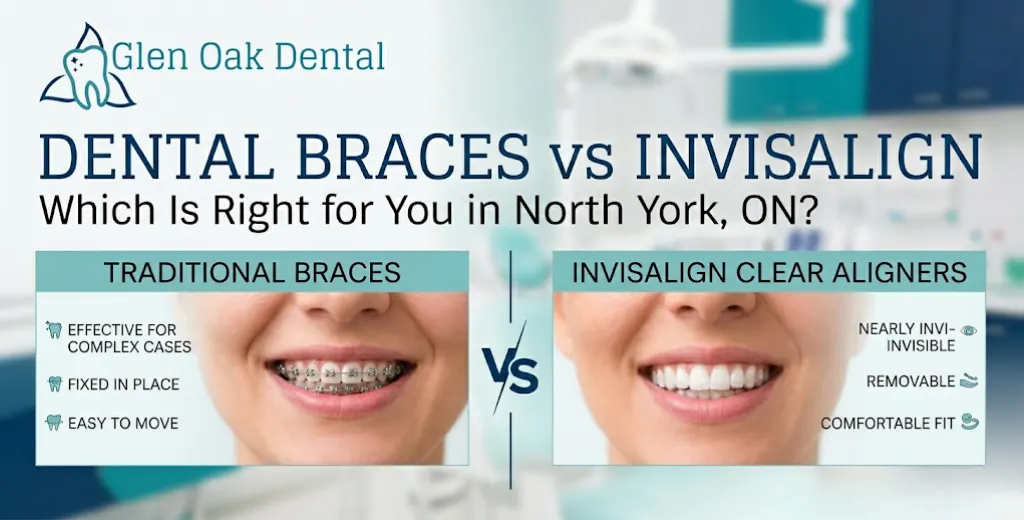
Both dental braces and Invisalign straighten teeth effectively — but each works differently. Braces are fixed, highly effective for all severity levels, and require zero compliance from the patient. Invisalign uses removable clear aligners that are nearly invisible, making them ideal for mild to moderate alignment issues in teens and adults. Your specific clinical needs, lifestyle, and budget determine which fits best. At Glen Oak Dental in North York, we guide every patient through this decision with a full clinical assessment — never a sales pitch.
Dental Braces vs Invisalign: Which Option Is Right for You?
If you’ve been searching for the best way to straighten your teeth, you’ve probably already asked: should I choose dental braces vs Invisalign? This ranks among the most common questions I hear in practice — and for good reason. Both options work, but each suits different clinical situations, lifestyles, and budgets.
This guide gives you an honest braces vs Invisalign comparison so you can walk into your next orthodontic consultation with confidence. No jargon. No overselling. Just clear, clinically grounded guidance you can actually use.
What Are Dental Braces?
Traditional dental braces are fixed orthodontic appliances bonded directly to your teeth. Metal brackets attach to each tooth and connect via a wire that your dentist or orthodontist adjusts over time. That steady, controlled pressure gradually shifts your teeth into proper alignment.
Modern braces are significantly smaller and more comfortable than older designs. Ceramic (tooth-coloured) brackets are also available for patients who prioritise aesthetics. Because braces are non-removable, they work around the clock regardless of patient compliance — a genuine clinical advantage for complex cases.
If other dental concerns accompany your misalignment, our cosmetic dentistry team can coordinate treatments to give you the best possible outcome.
What Is Invisalign?
Invisalign treatment uses a series of custom-made, removable clear aligners to move your teeth into position. Each set of aligners is typically worn for one to two weeks before you switch to the next tray in the sequence. The aligners are nearly invisible and come out for eating, drinking anything other than water, brushing, and flossing.
Refined over decades of clinical use, Invisalign now has a strong evidence base behind it. That said, specific limitations exist — and understanding those limitations is essential before choosing between dental braces vs Invisalign. To explore how we deliver Invisalign treatment in North York, visit our dedicated service page.
Dental Braces vs Invisalign: A Direct Comparison
The table below covers the factors that matter most — visibility, cost, compliance, effectiveness, and more — so you can assess the dental braces vs Invisalign decision clearly before your consultation.
| Factor | Dental Braces | Invisalign |
|---|---|---|
| Visibility | Noticeable (metal/ceramic) | Nearly invisible |
| Removability | Fixed — cannot be removed | Removable |
| Effectiveness | Highly effective for all severities | Best for mild to moderate cases |
| Compliance required | None (fixed) | Must wear 20–22 hrs/day |
| Diet restrictions | Avoid hard/sticky foods | Remove to eat anything |
| Oral hygiene | More involved brushing/flossing | Easier — remove to clean |
| Cost (approx. CAD) | $3,000–$7,000+ | $4,000–$8,000+ |
| Treatment duration | 12–36 months (varies) | 6–24 months (mild to moderate) |
| Suitable for children | Yes, including young children | Teens and adults preferred |
| Complex bite correction | Excellent | Limited — may need braces |
Is Invisalign Better Than Braces? What the Evidence Shows
Patients researching dental braces vs Invisalign often expect a clear winner. The clinical reality is more nuanced: neither option is universally superior. Each is a different tool suited to different situations.
When Invisalign Tends to Be the Better Choice
- You have mild to moderate crowding, spacing, or a minor overbite
- You’re an adult or responsible teen who will commit to wearing the removable aligners consistently — at least 20 to 22 hours each day
- Aesthetics during treatment matter to you professionally or socially
- You play contact sports or a musical instrument
- You want the freedom to eat without any dietary restrictions during treatment
When Braces Are Likely the Better Option
- You have severe crowding, significant bite issues (overbite, underbite, crossbite), or complex rotations — this is where bite correction treatment with fixed braces excels
- You’re choosing treatment for a child or younger teen — our children’s dentistry team regularly guides families through this decision
- Compliance is a concern — braces deliver results around the clock with no daily effort required from the patient
- Budget is a priority — braces often cost slightly less for complex cases
A Clinical Note on Severe Bite Issues
How Long Does Invisalign Take vs Braces? Treatment Timelines Explained
One of the most practical questions in the dental braces vs Invisalign decision involves time. Treatment timelines vary widely based on the complexity of your case — here’s what to expect at each level.
Mild Cases
Invisalign for mild to moderate alignment issues can deliver results in as few as 6 to 12 months. Traditional braces for similarly straightforward cases often take a comparable amount of time.
Moderate Cases
Invisalign typically runs 12 to 18 months for moderate complexity. Braces for the same complexity level may take 18 to 24 months, though the difference narrows when compliance is factored in.
Complex and Severe Cases
Severe crowding and significant bite correction often require 24 to 36+ months with braces. In many complex cases, Invisalign is not the recommended primary option. One factor significantly affects Invisalign timelines: you must wear the aligners 20 to 22 hours each day. Patients who remove them too often extend their own treatment — a variable that simply does not exist with fixed braces.
Cost of Dental Braces vs Invisalign in North York
In the greater Toronto and North York area, both treatment options typically fall within a similar price range — though costs vary based on case complexity, provider experience, and the specific Invisalign package selected. Are braces cheaper than Invisalign? Not always. The cost gap is smaller than most patients expect.
Glen Oak Dental offers flexible payment plans to make orthodontic treatment accessible to more families. Most Canadian dental insurance plans also provide partial orthodontic coverage, so check your benefits before assuming cost is a barrier. Get a personalised consultation with a full cost breakdown for your specific case before making any financial decision. Book an Invisalign consultation or braces assessment with our team any time.
Braces vs Invisalign for Crowded Teeth
Crowded teeth drives more orthodontic consultations than almost any other concern. For mild crowding, Invisalign produces excellent, predictable results. Both options work well for moderate crowding — your dentist will recommend based on the degree of movement required. For severe crowding, braces give your provider greater mechanical control over tooth movement and are generally the more reliable choice.
A clinical examination with X-rays is the only reliable way to categorise your crowding accurately — self-diagnosis from photos alone is not sufficient. If a tooth extraction is part of your orthodontic plan, our team coordinates all aspects of treatment under one roof.
Best Orthodontic Treatment for Adults: Dental Braces vs Invisalign
Adults frequently gravitate toward Invisalign for an obvious reason — metal brackets and a client meeting rarely mix well. For many adult patients, Invisalign is a genuinely excellent fit.
When Adults May Need Braces Instead
Some adults have dental histories that make braces the clinically smarter choice. Missing teeth requiring space management, significant prior restorative work, or complex overbite and underbite correction needs may all point toward fixed appliances. Adult bone structure is also denser than a teenager’s, which can affect how teeth respond to movement throughout treatment.
When missing teeth complicate the picture, exploring dental implants or dental bridges in coordination with your orthodontic plan is worth discussing at your consultation. The best orthodontic treatment for adults is always the one a dentist recommends after a thorough clinical assessment — not the option that appears most appealing in an advertisement.
Pros and Cons of Dental Braces vs Invisalign: A Quick Summary
Braces — Pros
- Highly effective across all complexity levels, including severe bite correction
- No daily compliance required — treatment continues around the clock
- Often more cost-effective for complex cases
- Suitable for patients of all ages, including young children
Braces — Cons
- Visible during treatment — though our teeth whitening and cosmetic services help restore your smile confidence afterward
- Dietary restrictions apply — hard, sticky, and crunchy foods must be avoided
- Oral hygiene around brackets requires more effort — regular teeth cleaning appointments become even more important
- Minor discomfort after each adjustment appointment is common
Invisalign — Pros
- Nearly invisible — minimal impact on your daily appearance
- Removal for eating, drinking, brushing, and flossing makes oral hygiene straightforward
- Fewer emergency visits for broken brackets or wires — though our emergency dental team remains available same-day when needed
- Smooth plastic construction — no sharp wires against soft tissue
Invisalign — Cons
- Strict daily discipline required — 20 to 22 hours of wear every day
- Not the optimal choice for complex or severe orthodontic cases
- Aligners can be lost or damaged, which delays treatment
- Tooth-coloured attachments (small bumps bonded to teeth) may be needed and add some visibility
How to Choose Between Dental Braces vs Invisalign: A 5-Step Framework
Here is the framework I walk every patient through when deciding between clear aligners vs braces:
- Start with clinical need — severity of misalignment and the type of bite correction treatment required should drive the decision more than any other factor
- Assess your lifestyle honestly — removability is a genuine advantage for working adults, but only when you’ll commit to daily compliance
- Consider age — younger patients, especially children, typically do better with fixed braces; our children’s dentist team can advise from the very first visit
- Review your budget and insurance — request quotes for both options and check your dental benefits before deciding
- Trust your provider’s clinical recommendation — a thorough, in-person assessment is irreplaceable
What the ADA, CDA, and Health Canada Say About Orthodontic Treatment
All three major dental and health authorities recognise both dental braces and Invisalign as clinically valid orthodontic treatment options — with one consistent emphasis: proper case selection matters above all else.
American Dental Association — Evidence-Based Guidance
The American Dental Association (ADA) recognises both fixed appliances and clear aligner systems as accepted orthodontic treatments. The ADA emphasises that treatment selection must reflect clinical diagnosis — including misalignment severity, bite classification, and compliance potential — rather than patient preference alone.
Canadian Dental Association — Patient-Centred Decision Making
The Canadian Dental Association (CDA) supports individualized orthodontic care and encourages every patient to explore all available teeth-straightening options with their dental provider. The CDA highlights that a thorough clinical exam — including X-rays and bite analysis — is essential before any orthodontic treatment recommendation.
Health Canada — Regulated Dental Devices
Health Canada regulates both traditional orthodontic brackets and clear aligner systems as Class II medical devices. Every orthodontic appliance available in Canadian dental clinics meets federal safety and effectiveness standards before a dentist can offer it to patients.
All three organizations share one consistent recommendation: base orthodontic decisions on a complete clinical examination — not advertising, cost assumptions, or word-of-mouth comparisons.
Frequently Asked Questions: Dental Braces vs Invisalign
How This Article Was Created
A dental professional at Glen Oak Dental wrote this article based on current evidence-based clinical guidelines for orthodontic treatment. Clinical information references guidance from the American Dental Association (ADA), the Canadian Dental Association (CDA), and Health Canada. Content follows 2026 SEO and AI optimization best practices including semantic keyword use, LSI keyword placement, NLP-friendly structure, voice search readiness, and featured snippet optimization. All clinical claims reflect current, verifiable orthodontic guidance. This content is for general information only and does not replace advice from a licensed dental professional.
Still Deciding Between Dental Braces vs Invisalign? Talk to Our Team.
Glen Oak Dental — 2827 Bathurst Street, North York, ON M6B 3A4
Phone: 416-551-8480 | glenoakdental.ca
Led by Dr. Roya Khoshsar, D.D.S. — 15+ years of clinical experience, North York
Open 7 days a week | Accepting new patients of all ages | Direct insurance billing available
Whether you’re weighing up dental braces vs Invisalign, looking for affordable Invisalign plans, or simply ready to book an orthodontic consultation — our team delivers a full clinical assessment and honest guidance at every step.