
Dr. Roya Khoshsar, D.D.S. | General, Cosmetic & Restorative Dentist, Glen Oak Dental, North York
15+ years of clinical experience | Follows Canadian Dental Association (CDA) guidelines
Introduction
If your dentist has recommended a dental crown, you are in good company — crowns are one of the most common restorative treatments in modern dentistry. Whether you have a cracked molar, a large cavity, or a tooth that has had a root canal, a crown can protect what remains and restore full function.
At Glen Oak Dental, located at 2827 Bathurst Street in North York, Dr. Roya Khoshsar and the team place dental crowns using current materials and digital impression technology. As a result, this guide covers everything patients in North York, Forest Hill, Glencairn, and surrounding areas need to know before booking a consultation.
What Is a Dental Crown?
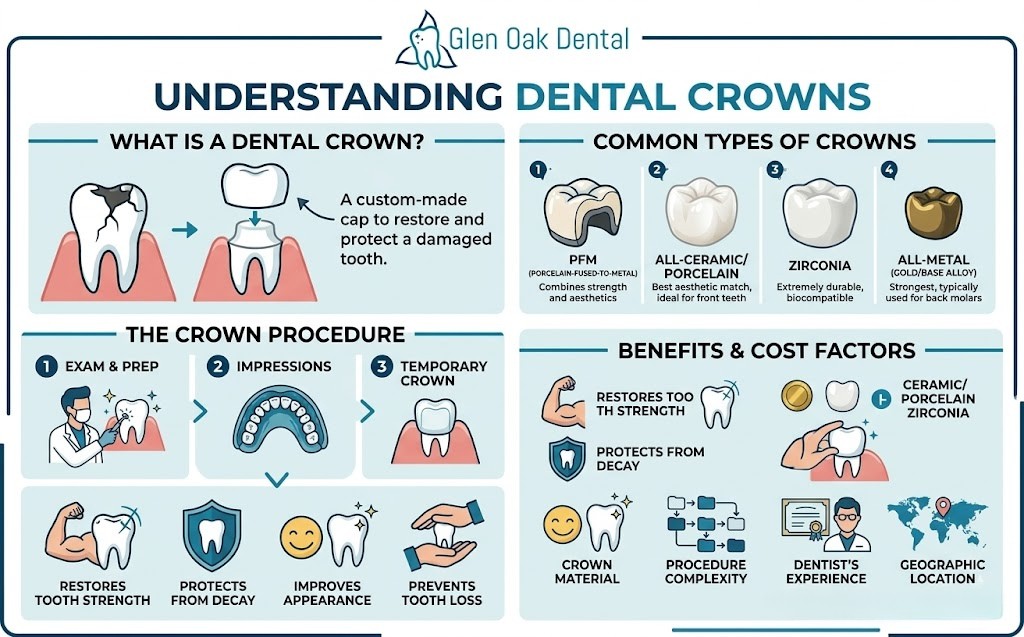
A dental crown — also called a dental cap — is a tooth-shaped covering that fits over the entire visible portion of a damaged or weakened tooth, from the top down to the gum line. In other words, think of it as a protective shell that rebuilds the tooth’s original shape, size, and strength.
In dentistry, crowns serve both functional and cosmetic purposes. Furthermore, according to the Canadian Dental Association, crowns rank among the most commonly recommended restorative treatments for damaged or compromised teeth. Specifically, they help with the following:
- Protecting a weak tooth from fracturing
- Restoring a broken or severely worn tooth
- Covering a tooth after root canal therapy
- Anchoring a dental bridge in place
- Improving the appearance of a discoloured or misshapen tooth
- Capping a dental implant
When Do You Need a Dental Crown?
Not every damaged tooth needs a crown. Instead, your dentist will recommend one when a filling is no longer sufficient to restore function or prevent further damage. The following situations most commonly call for a crown:
Severe tooth decay
When decay destroys too much of the natural tooth structure for a filling to hold reliably, a crown restores the full tooth shape. If you are overdue for a checkup, our professional teeth cleaning and exam appointments can catch decay early — before a crown becomes necessary.
Cracked or fractured tooth
A crack that extends below the gum line is a serious problem. Specifically, a crown holds the tooth together and stops the crack from spreading — which could otherwise lead to extraction. If you experience sudden pain from a cracked tooth, our emergency dentist in North York offers same-day appointments.
After a root canal
Root canal-treated teeth become brittle over time. As a result, they are far more vulnerable to fracturing during everyday chewing. A crown protects them effectively and extends their lifespan significantly. At Glen Oak Dental, we routinely recommend crowning a tooth after root canal treatment to ensure long-term durability.
Crown on a molar
Molars handle the highest bite force in your mouth. Consequently, a crown on a molar is particularly important because unprotected molars crack far more easily under pressure — especially after large fillings or root canal treatment.
Cosmetic improvement
Dentists can also correct severely discoloured, misshapen, or undersized teeth with a porcelain or zirconia crown for a natural, uniform appearance. Our cosmetic dentistry team at Glen Oak Dental can help you explore whether a crown or an alternative treatment best suits your goals.
Porcelain and ceramic crowns
These are the top choice for front teeth where appearance matters most. Dentists match them to the exact shade of your surrounding teeth, and they contain no metal — making them ideal for patients with metal sensitivities. Additionally, you can explore more aesthetic options through our cosmetic dentistry services.
Zirconia crowns
Zirconia has become the most popular modern crown material. It combines the strength of metal with the aesthetics of porcelain — making it suitable for both front and back teeth. For this reason, the team at Glen Oak Dental frequently recommends zirconia crowns to patients who want durability without compromising appearance.
The Dental Crown Procedure: Step by Step
At Glen Oak Dental, the team completes the standard crown procedure over two appointments, typically 1–2 weeks apart.
Step 1 — Examination and tooth preparation
Dr. Khoshsar begins with a thorough exam, which may include digital X-rays to assess the tooth root and surrounding bone. First, she removes any decay that is present. Next, she shapes the tooth by removing a small amount of enamel from all sides to create room for the crown. Throughout the appointment, she uses local anaesthetic to keep the procedure comfortable.
Step 2 — Digital impressions
Glen Oak Dental uses digital impression technology to capture a precise 3D image of the prepared tooth and surrounding teeth. The team then sends this image to the dental lab to fabricate the custom crown. Compared to traditional putty impressions, digital impressions are faster, more comfortable, and more accurate.
Step 3 — Temporary crown
Dr. Khoshsar places a temporary crown over the prepared tooth to protect it while the permanent crown is in production. You can eat normally during this time, though it is best to avoid harder or stickier foods.
Step 4 — Permanent crown placement
When the permanent crown arrives from the lab — typically within 1–2 weeks — you return for a short follow-up appointment. Dr. Khoshsar removes the temporary crown, checks the permanent one for fit, bite, and colour match, makes any necessary adjustments, and cements it permanently. In most cases, the entire second visit takes 30–45 minutes.
Dental Crown vs. Dental Filling: Key Differences
Both crowns and fillings repair damaged teeth, but they serve different purposes. The table below highlights the key differences:
| Feature | Dental Crown | Filling |
|---|---|---|
| Coverage | Full tooth | Partial only |
| Strength | Very high | Moderate |
| Best for | Severe damage | Minor cavities |
| Durability | 10–15+ years | 5–10 years |
| Procedure | 2 visits | Single visit |
The key deciding factor is how much healthy tooth structure remains. When a tooth loses more than roughly half its structure to decay or damage, a filling alone cannot adequately protect it. In that case, a crown becomes the right choice.
Cost of Dental Crowns in North York
Crown costs in North York vary based on the material, the tooth location, and the complexity of the case. Generally speaking, the following ranges reflect typical fees at private dental clinics in the Toronto area:
- Porcelain / ceramic crown: $900 – $1,500
- Zirconia crown: $1,000 – $1,800
- Porcelain-fused-to-metal crown: $900 – $1,500
- Metal / gold crown: $800 – $1,500
Insurance and payment options
Glen Oak Dental direct-bills Sun Life, Manulife, Great-West Life, Equitable Life, and most other major Canadian insurance providers. In most cases, dental insurance covers crowns under restorative benefits at 50–80% depending on your plan. Our front desk handles all insurance paperwork directly, so you can focus on your care.
For patients without insurance, we discuss payment options at the time of consultation. We always provide a clear, itemised treatment estimate before any work begins. Contact us to book a no-obligation consultation.
How Long Do Dental Crowns Last?
Most dental crowns last between 10 and 15 years with proper care. High-quality zirconia and metal crowns often last even longer — typically 15–20 years or more. Research published in the Journal of the Canadian Dental Association (JCDA) confirms crown survival rates exceeding 90% at the 10-year mark when experienced clinicians place them using quality materials.
What affects crown lifespan?
Several habits and factors determine how long your crown lasts. Specifically, the following play the biggest role:
- Oral hygiene — brush twice daily and floss around the crown margin
- Avoid biting hard objects such as ice, hard candy, or pens
- Wear a night guard if you grind your teeth (bruxism)
- Attend regular check-ups and professional cleanings at Glen Oak Dental so the team can inspect the crown for early signs of wear
Is Getting a Dental Crown Painful?
Dr. Khoshsar performs the crown preparation appointment under local anaesthetic, so the procedure itself does not cause pain. You may feel some pressure and vibration, but the team manages your comfort throughout. In fact, most patients are surprised by how straightforward the experience is.
What to expect after the procedure
After the anaesthetic wears off, it is normal to experience mild sensitivity around the prepared tooth for a few days — particularly to hot and cold temperatures. Over-the-counter pain relief such as ibuprofen or acetaminophen is usually sufficient. However, if sensitivity persists beyond a week or you experience significant pain, contact Glen Oak Dental for a follow-up. This is rare, but it occasionally indicates the tooth needs further assessment.
Dental Crowns Near You — Serving North York and Surrounding Areas
Glen Oak Dental is located at 2827 Bathurst Street, North York. As a result, we conveniently serve patients from across the area, including:
- Lawrence Heights and Lawrence Manor
- Forest Hill and Cedarvale
- Glencairn and Bathurst Manor
- Yorkdale and Downsview
- Midtown Toronto and Willowdale
- Wilson Heights and Clanton Park
The clinic sits a short walk from Lawrence West Station on the TTC Yonge-University line. Additionally, on-site parking is available for patients who drive. Glen Oak Dental is currently accepting new patients of all ages.
Common Questions About Dental Crowns — Answered
Below are the most common questions our North York patients ask about dental crowns. If you do not find your answer here, contact our team directly.
Conclusion
A dental crown is one of the most reliable restorative treatments available. Whether you need to protect a cracked tooth, restore a molar after a root canal, or improve the appearance of a front tooth through cosmetic dentistry, crowns provide a long-lasting solution that restores both function and confidence.
If your dentist has told you that you may need a crown — or you are experiencing tooth pain, visible cracks, or sensitivity — the right first step is a consultation to assess exactly what your tooth needs. In short, early treatment is always less complex and less costly than waiting. Furthermore, for families across North York, our family and children’s dentistry services ensure complete care for every member of your household.
Book a Dental Crown Consultation at Glen Oak Dental
Glen Oak Dental — 2827 Bathurst Street, North York, ON M6B 3A4
Phone: 416-551-8480 | Website: glenoakdental.ca
Led by Dr. Roya Khoshsar, D.D.S. — 15+ years of experience in North York
Minutes from Lawrence West TTC Station. Parking available on-site. Now accepting new patients.
Glen Oak Dental follows all clinical guidelines of the Canadian Dental Association (CDA). All treatment recommendations are based on evidence-based practice and individual patient assessment.