
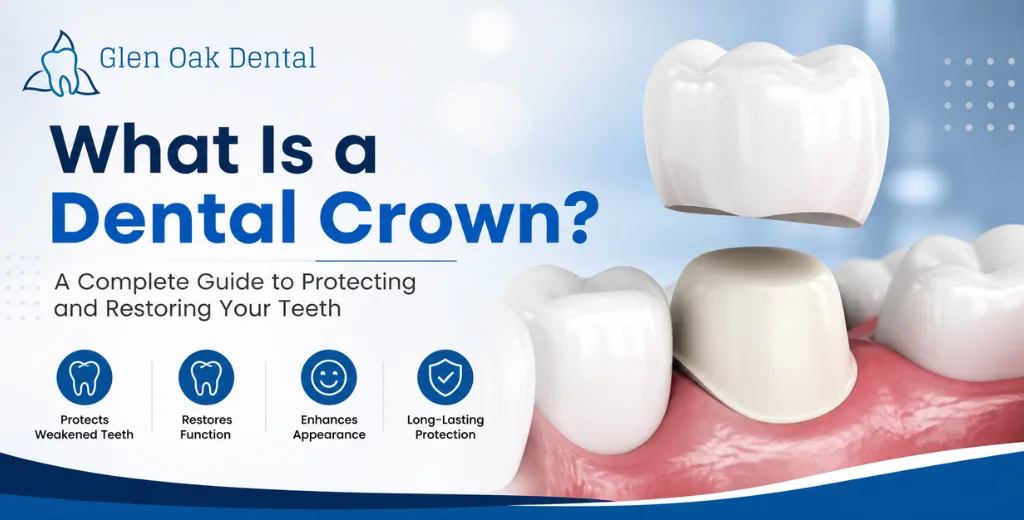
A dental crown is a custom-made cap placed over a damaged or weakened tooth. It restores the tooth’s strength, shape, and appearance. Dentists use crowns after root canal treatment, severe decay, cracking, or heavy wear. At Glen Oak Dental in North York, we assess every case with digital X-rays. We recommend a crown only when it is the most conservative option that genuinely protects your tooth long term.
What Is a Dental Crown? A Complete Guide to Protecting and Restoring Your Teeth
A dental crown is one of the most commonly recommended restorative treatments in dentistry — and one of the most misunderstood. If your dentist told you that you might need one, it is natural to have questions. You may wonder what the procedure involves, whether it is truly necessary, and how it will affect your smile and budget.
Understanding what a dental crown is helps you make confident, informed decisions about your oral health. A dental tooth crown reliably restores damaged teeth while preserving as much natural tooth structure as possible. This guide covers every aspect of dental crowns. We explain the types and materials available, the step-by-step procedure, realistic cost expectations in Canada, and what leading dental authorities say about when a crown is the right call.
If you are experiencing tooth pain or a dentist has advised restorative care, our restorative and cosmetic dental team in North York offers same-day consultations for urgent cases.
What Is a Dental Crown?
A dental crown is a custom-made cap that fits completely over a tooth — from the gum line upward. It restores the tooth’s original size, shape, strength, and appearance. Once your dentist cements it in place, the crown covers the entire visible surface and functions just like a natural tooth.
You may also hear the terms dental tooth crown, crown tooth, dental crowns teeth, or what is a cap in dentistry. All of these describe the same restorative treatment. A dental cap and a dental crown are identical — “cap” is simply the informal term patients use.
Technicians fabricate crowns in a dental crown laboratory from impressions or digital scans taken at your appointment. At Glen Oak Dental, we use digital scanning technology to ensure a precise fit and a natural-looking result every time.
When Do You Need a Dental Crown?
A dental crown becomes necessary when a tooth is too damaged, weakened, or decayed for a standard filling to protect it adequately. Several distinct clinical situations call for crown placement.
Common Reasons Your Dentist May Recommend a Dental Crown
1. Cracked or Broken Tooth
A crack that extends beyond the surface enamel cannot be stabilised with a filling. A dental crown holds the tooth together, prevents the crack from spreading to the root, and restores full biting function.
2. Severe Tooth Decay
When decay destroys too much natural tooth structure for a filling to bond reliably, a crown becomes the most dependable long-term solution. Our emergency dental team in North York regularly manages urgent decay cases where same-day crown assessment is needed.
3. Large Existing Filling
A large, old filling that has cracked or failed leaves the remaining tooth structure vulnerable. Replacing it with a crown provides structural support that a new filling alone cannot offer.
4. After Root Canal Treatment
Teeth that have undergone root canal treatment become brittle and prone to fracture without a crown. Both the American Dental Association (ADA) and the Canadian Dental Association (CDA) consider placing a crown after root canal treatment standard clinical care.
5. Worn Teeth from Grinding (Bruxism)
Bruxism grinds teeth down significantly, causing enamel and structural height loss. Crowns rebuild the tooth to its proper dimensions and protect it from further wear.
6. Dental Implant Crown
A dental implant crown is the visible tooth-shaped component placed on top of a dental implant post. If you want to replace a missing tooth, our dental implant team in North York assesses whether an implant-supported crown fits your needs.
7. Cosmetic Restoration
When a tooth is severely discoloured, misshapen, or structurally compromised beyond what veneers can correct, a crown delivers both cosmetic improvement and structural protection. Our cosmetic dentistry team discusses all options with you before recommending a crown for aesthetic reasons.
Types of Dental Crowns and Their Costs
Choosing the right crown material depends on the tooth’s location, the forces it bears, your aesthetic preferences, and your budget. Understanding the main types of dental crowns helps you have a more informed conversation with your dentist.
1. Metal Crowns
Metal crowns — typically gold or base-metal alloys — are exceptionally durable. They require minimal tooth removal and withstand chewing forces better than most alternatives. They rarely chip or break. Because of their metallic colour, dentists almost always place them on back molars where appearance is less of a concern. Metal crown costs in Canada generally fall at the lower end of the crown price range.
2. Ceramic (All-Porcelain) Dental Crown
A ceramic dental crown is the most natural-looking option available. It suits front teeth where aesthetics matter most, and it works well for patients with metal sensitivities. Technicians can colour-match porcelain precisely to surrounding teeth. The trade-off is that ceramic chips more easily than metal or zirconia under heavy biting forces.
3. Zirconia Dental Crown
A zirconia dental crown (also called a zirconium dental crown) combines the strength of metal with the appearance of porcelain. Zirconia is extremely hard, biocompatible, and translucent enough to mimic natural tooth enamel convincingly. Many dentists consider it the premium all-rounder for both front and back teeth. Zirconia dental crown costs sit at the higher end of the range, but most patients find the durability and aesthetics well worth the investment.
4. E-Max Dental Crown
An e max dental crown uses lithium disilicate — a high-strength glass-ceramic with outstanding translucency. E-max crowns match the light-reflecting properties of natural enamel almost exactly. This makes them a preferred choice for highly visible front teeth. They are also strong enough for most posterior applications.
5. Porcelain-Fused-to-Metal (PFM) Crown
Porcelain-fused-to-metal crowns combine a metal substructure with a porcelain outer layer. They offer greater strength than all-ceramic options while maintaining a tooth-coloured appearance. As gums recede, a thin dark line can appear at the gum line — which is the main aesthetic limitation compared to full-ceramic alternatives.
6. Molar Crown
A molar crown covers the back teeth that bear the heaviest chewing load. Dentists typically make molar crowns from metal, zirconia, or PFM because these materials best handle the forces generated during chewing and grinding.
What Are Dental Crowns Made Of?
The dental crown material your dentist selects affects durability, appearance, cost, and how much natural tooth structure the preparation removes.
Choosing the Right Crown Material for Your Tooth
Modern crown fabrication uses four primary materials: ceramic (all-porcelain), zirconia, metal alloys (including gold), and porcelain-blended composites. Each performs best in specific applications. Ceramic and e-max materials excel on front teeth where aesthetics dominate. Zirconia and metal suit molars where strength takes priority.
A qualified dentist evaluates the location of the tooth, the condition of the surrounding bite, and your own priorities before recommending a specific dental crown material. At Glen Oak Dental, accredited dental crown laboratories in Canada fabricate all crowns using materials that meet current clinical standards.
Dental Crown Procedure Explained: Step by Step
The dental crown procedure is straightforward and comfortable under local anaesthetic. Most patients complete the process in two appointments, though same-day dental crowns are available at some clinics using in-office milling technology.
Step 1: Examination and Digital X-Rays
Your dentist examines the tooth and takes digital X-rays to assess the root and surrounding bone. This confirms that a crown is the appropriate treatment. At Glen Oak Dental, we never recommend a crown without a thorough clinical assessment first.
Step 2: Tooth Preparation
The dentist reshapes the tooth by removing a thin, uniform layer of enamel from all surfaces. This creates space for the crown to fit over the tooth without adding unwanted bulk to your bite. Local anaesthetic ensures you feel no discomfort during this stage. The amount of tooth removed depends on the crown material chosen — metal crowns require less removal than ceramic ones.
Step 3: Digital Scan or Impression
Your dentist takes a precise digital scan (or traditional impression) of the prepared tooth. This record goes to the dental crown laboratory, where technicians fabricate your permanent crown to exact specifications.
Step 4: Temporary Crown Placement
Your dentist places a temporary crown over the prepared tooth to protect it while the permanent crown is being made — typically one to two weeks. Temporary crowns are less durable than permanent ones, so avoid hard or sticky foods during this period. If a temporary crown loosens, dental adhesive for crowns or temporary dental cement for crowns from a pharmacy can re-seat it short-term. Contact your dental office promptly for proper reattachment.
Step 5: Permanent Crown Placement
When the permanent crown is ready, your dentist removes the temporary and checks the permanent crown for fit, bite, and colour match. Once confirmed, the dentist cements it permanently in place. The result is a fully restored tooth that functions and looks natural.
If you have concerns about a dental crown and pain during the procedure, speak with your dentist beforehand. With modern local anaesthetic, patients report very little discomfort during crown preparation. Some sensitivity after the anaesthetic wears off is normal and typically settles within a few days. Our emergency dental team is reachable if you experience unexpected pain after placement.
Dental Crown Cost in Canada: What to Expect
Understanding dental crown cost in Canada is important for planning your care. Crown costs vary based on the material used, the complexity of the case, and the dental clinic’s location.
Typical Dental Crown Cost Range in Canada
In Canada, a dental crown generally costs between approximately $**** and $**** per tooth, depending on the material. Metal and PFM crowns tend to sit at the lower end of the range. Zirconia dental crown costs and e-max dental crown costs typically sit higher due to the premium materials involved. Dental crown cost and urban centres like North York may be slightly higher than in rural areas due to overhead differences.
Does the Canadian Dental Plan Cover Crowns?
Many patients ask: does the Canadian Dental Plan cover crowns? The Canada Dental Plan provides coverage for eligible Canadians. Crowns may receive partial coverage when a dentist deems the treatment clinically necessary. Coverage eligibility and amounts depend on your individual plan and income threshold.
At Glen Oak Dental, we direct bill Sun Life, Manulife, Great-West Life, Equitable Life, and most major Canadian insurance providers. Our front desk team checks your coverage before your appointment so you know your out-of-pocket costs upfront. For patients with private dental insurance, plans often cover crowns at 50% after the deductible, subject to annual maximums and waiting periods. We recommend calling your insurer or letting our team submit a predetermination before you book treatment.
How Long Do Dental Crowns Last?
Most dental crowns last between 10 and 15 years with proper care, and many last considerably longer. The crown material, biting forces, oral hygiene, and how regularly the patient attends dental appointments all affect lifespan.
Maintenance Tips to Extend Your Crown’s Lifespan
- Brush twice daily and floss around the crown, paying attention to the gum line where the crown meets the tooth
- Avoid chewing ice, hard candies, or using your teeth as tools — habits that can crack even a strong crown
- Wear a night guard if you grind your teeth; grinding dramatically accelerates crown wear
- Attend routine professional teeth cleaning appointments in North York every six months so your dentist can check the crown’s integrity and the health of the underlying tooth
- Report any changes in bite or sensitivity promptly — catching a loose crown early prevents damage to the underlying tooth
When Does a Crown Need to Be Replaced?
A crown may need replacement if it chips or fractures, if the underlying tooth develops new decay at the margin, if the gum tissue recedes significantly, or if the cement seal breaks down over time. In a genuine emergency — such as a crown that has fully come off — temporary dental glue for crowns available at pharmacies can re-seat the crown short-term. Contact your dental office the same day for proper recementation. Our same-day emergency dental team at Glen Oak Dental handles lost or broken crowns promptly.
When a crown eventually needs replacement and the underlying tooth has deteriorated beyond restoration, dental implants in North York or dental bridges are excellent long-term replacement options our team can discuss with you.
Dental Cap vs Dental Crown: Is There a Difference?
No — a dental cap and a dental crown are the same thing. “Cap” is the everyday informal term patients use. “Crown” is the clinical dental term that dentists and insurance companies use. Both describe a tooth-shaped restoration that covers the entire visible surface of a prepared tooth. You may also see the phrase dental cap or crown in insurance documentation — they always mean the same treatment.
Dental Implants vs Crowns: Understanding the Difference
Patients sometimes ask about dental implants vs crowns when a tooth is badly damaged. The distinction is straightforward. A dental crown restores and covers an existing natural tooth root. A dental implant replaces a tooth that has already been extracted or lost — the implant post substitutes for the root, and a dental implant crown sits on top to replicate the visible tooth.
If your natural tooth root is still intact and can support a crown, a crown is almost always the more conservative — and preferable — choice. If the tooth must be extracted, a dental implant offers the most durable long-term replacement. Our implant and restorative team in North York evaluates each case individually and explains all your options clearly before treatment begins. Where extraction leaves a gap that can be bridged without implants, our dental bridge service offers a reliable and cost-effective alternative.
Disadvantages of Dental Crowns: What You Should Know
Dental crowns are highly effective, but understanding their limitations before committing to treatment is important.
- Irreversible tooth preparation: Placing a crown requires removing enamel, which cannot be restored. Once your dentist prepares a tooth for a crown, it will always need crown coverage.
- Sensitivity after placement: Some patients experience temporary sensitivity to hot or cold in the days following crown placement. This normally resolves on its own.
- Potential for new decay: If you do not maintain oral hygiene at the crown margin, new decay can develop at the gum line beneath the crown.
- Cost: Crowns are a significant investment. Understanding your insurance coverage and available payment options before starting treatment is important.
- Possible need for replacement: No crown lasts forever. Planning for eventual replacement — typically after 10 to 15 or more years — is part of realistic long-term dental planning.
When a dentist recommends a crown, these trade-offs should be part of an open conversation. At Glen Oak Dental, we present all options, including more conservative alternatives where they exist, and let you make an informed decision.
What the ADA, CDA, and Health Canada Say About Dental Crowns
All three major dental and health authorities provide consistent, evidence-based guidance on when dental crowns are clinically appropriate and how treatment decisions should be made.
American Dental Association — Evidence-Based Clinical Guidelines
The American Dental Association (ADA) recognises dental crowns as a well-established restorative treatment. Crowns address teeth that are too damaged or weakened for a filling to restore reliably. Importantly, the ADA emphasises that clinical evidence must ground treatment recommendations. X-rays, examination findings, and the patient’s individual health picture all factor into the decision — not blanket protocols. The ADA broadly supports crowns after root canal treatment and for teeth with significant structural loss.
Canadian Dental Association — Patient-Centred Decision Making
Similarly, the Canadian Dental Association (CDA) supports the use of dental crowns when clinical findings justify them. The CDA encourages individualised care. The same damaged tooth may receive different management in different patients, depending on overall oral health, age, bite forces, and personal preferences. All clinical care at Glen Oak Dental follows CDA guidelines, and we encourage patients to ask questions until they feel confident in any recommended treatment plan.
Health Canada — Oral Health as a Public Health Priority
Furthermore, Health Canada recognises oral health as an important component of overall wellbeing. Untreated tooth damage — whether from decay, fracture, or failed restorations — can progress to infection, tooth loss, and broader health complications. Health Canada’s dental benefit programs, including the Canada Dental Plan, reflect a commitment to making essential dental treatments including crowns more accessible to eligible Canadians.
Frequently Asked Questions: Dental Crowns
How This Article Was Created
A dental health professional with clinical experience in general and restorative dentistry wrote this article. The content reflects current evidence-based clinical guidelines from the American Dental Association (ADA), the Canadian Dental Association (CDA), and Health Canada.
Need a Dental Crown in North York? Talk to Our Team Today.
Glen Oak Dental — 2827 Bathurst Street, North York, ON M6B 3A4
Phone: 416-551-8480 | glenoakdental.ca
Led by Dr. Roya Khoshsar, D.D.S. — 15+ years of clinical experience in North York
Same-day emergency appointments available | Accepting new patients of all ages | Direct insurance billing
Whether you need a dental crown assessment, want to understand your dental crown cost and insurance options, or are ready to discuss dental implants or dental bridges as alternatives — our team delivers a full clinical assessment and honest guidance at every step.