
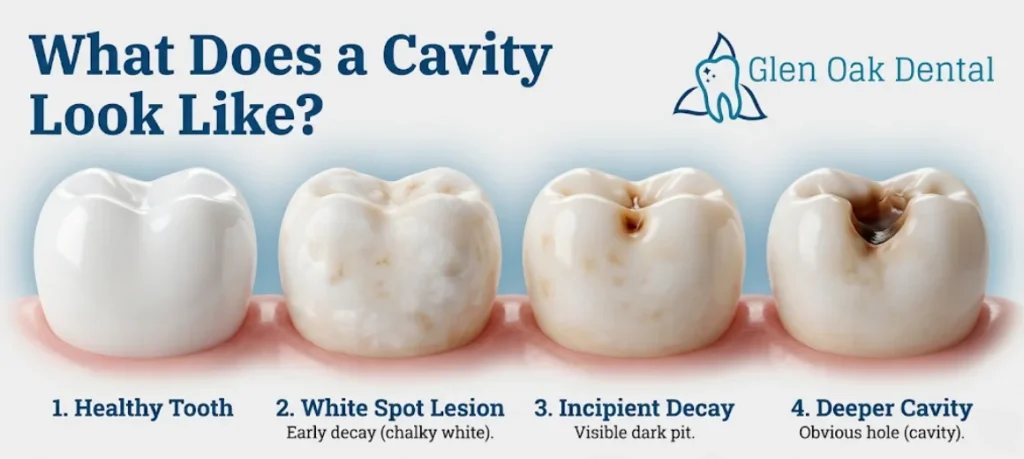
What Does a Cavity Look Like? A Complete Visual Guide to Tooth Decay
If you’ve ever run your tongue over a tooth and felt something rough, dark, or strangely soft — you already know the anxiety that follows. What does a cavity look like? Can you actually see one? And more importantly, can you catch it early enough to avoid a painful trip to the dental chair?
These are questions millions of people search every day. This guide will walk you through every stage of tooth decay, from the earliest warning signs to advanced damage, so you know exactly what to look for — and when to act.
What Is a Cavity, and Why Does It Form?
A cavity — also called dental caries or tooth decay — is permanent structural damage to the hard outer surface of your tooth. It forms when bacteria in your mouth feed on sugars, producing acids that slowly erode tooth enamel over time.
Cavities don’t announce themselves. That’s what makes them so dangerous. You can have a cavity and not know it, especially in the early stages when the damage is microscopic and pain-free.
The result? Most people only notice decay when it’s already progressed — which is exactly why visual identification matters so much. If it has already advanced, our full range of dental services at Glen Oak Dental can help restore your tooth at any stage.
What Does a Cavity Look Like? Breaking It Down by Stage
Understanding what a cavity looks like requires understanding that tooth decay moves through distinct stages. Each stage looks different, feels different, and requires a different level of treatment.
Stage 1: White Spot Lesions (The Very Beginning)
In the beginning stages of a cavity, you won’t see a hole or a dark spot. Instead, you’ll notice a chalky white or off-white area on the surface of the tooth. This is caused by demineralization — the enamel is losing calcium and phosphate before it physically breaks down.
What does a cavity look like when it first starts?
- A dull, opaque white patch on the enamel
- No visible hole yet
- No pain in most cases
- Often found near the gumline or between teeth
This is the only stage where a cavity can potentially reverse itself through fluoride treatment and better oral hygiene — which is exactly why early detection is so critical. Routine teeth cleaning appointments help catch white spot lesions before they progress further.
Stage 2: Enamel Decay (Small but Visible)
Once enamel begins to break down, you start to see what most people think of as a “real” cavity. This is what a small cavity looks like:
- A light brown, yellowish, or grayish discoloration on the tooth surface
- A slightly rough or pitted texture you might feel with your tongue
- A tiny hole or indentation, most visible on molars in the chewing surface grooves
- No significant pain yet, though some sensitivity to cold or sweet foods may develop
At this point, a dentist can restore the tooth with a simple filling. The damage is still confined to the outer enamel layer.
Stage 3: Dentin Decay (Advancing Quickly)
When decay breaks through the enamel and reaches the dentin — the softer layer beneath — the cavity grows faster and starts to become symptomatic.
What does a cavity look like on a tooth at this stage?
- A more obvious dark brown or black hole in the tooth
- A visibly larger pit or crater
- Sensitivity to hot, cold, sweet, and acidic foods
- Mild to moderate pain when biting down
This is often the stage where people finally feel something and schedule a dentist visit. The discoloration becomes hard to miss, and the tooth may visibly look darkened or structurally compromised.
Stage 4: Pulp Involvement (Severe Decay)
When decay reaches the pulp — the innermost nerve and blood vessel tissue of the tooth — what does a bad cavity look like?
- A large, dark, visibly broken section of tooth
- Black or very dark brown coloring across a significant portion of the surface
- Obvious structural damage, crumbling edges, or missing tooth material
- Intense, throbbing pain (or in some cases, a sudden stop in pain if the nerve has died)
- Possible swelling in the gum tissue nearby
At this stage, a root canal or tooth extraction is typically required. The damage is no longer cosmetic — it’s a health issue.
What Does a Cavity Look Like on a Molar vs. a Front Tooth?
Location matters enormously when identifying decay visually.
On a molar, cavities most commonly develop in the deep grooves of the chewing surface. What does a cavity look like on a molar? Look for:
- Dark spots in the pits and fissures of the back teeth
- Discoloration that doesn’t wipe off
- A surface that looks “stained” in specific grooves, not across the whole tooth
- Between-tooth decay that’s often invisible until an X-ray reveals it
On a front tooth, cavities tend to appear near the gumline or between teeth. They often show as:
- A yellowed or brown edge near the gum
- A visible dark triangle between two front teeth
- White spots that have progressed to tan or brown
Between teeth, cavities are typically invisible to the naked eye until they’re quite advanced — which is exactly why routine X-rays during your dental check-up are essential.
What Does Tooth Decay Look Like? Colors and Textures Explained
A lot of people wonder: what color is a cavity? Here’s a simple visual breakdown:
- White or chalky — Very early demineralization, not yet a true cavity
- Yellow or tan — Early enamel decay; surface is beginning to break down
- Light brown — Moderate enamel or early dentin decay
- Dark brown — Active or arrested dentin decay (arrested cavities can appear dark but stable)
- Black — Advanced decay, possibly dead pulp tissue, or arrested decay in enamel (common in pit-and-fissure areas)
Not all dark spots are active cavities. Some are staining from food, coffee, or tobacco. The difference is that stains sit on the surface and don’t disrupt the tooth’s texture, while decay creates actual pitting or softness. According to the Canadian Dental Association, regular professional examinations remain the most reliable method of distinguishing staining from active decay.
Can You Feel a Cavity With Your Tongue?
Yes — often you can. Many people first discover a potential cavity by feel before they ever see it.
What does a cavity feel like with your tongue?
- A small rough patch or indentation on a normally smooth surface
- A sticky or “catching” sensation when you run your tongue across the tooth
- A sharp edge where the enamel has chipped or crumbled slightly
- Occasionally, a hole large enough to feel clearly
However, not every rough spot is a cavity, and many cavities — especially between teeth or under existing fillings — can’t be felt at all. Physical sensation is a clue, not a diagnosis.
What Does Cavity Pain Feel Like?
Pain is often the symptom that finally sends people to the dentist, but by the time it arrives, the decay is usually already significant.
What does cavity pain feel like?
- Sharp, brief pain triggered by cold, sweet, or acidic foods — common in enamel and early dentin cavities
- Lingering sensitivity that stays for several seconds to a minute after the trigger — indicates dentin or pulp involvement
- Spontaneous, throbbing pain that occurs without any trigger — a sign the pulp is inflamed or infected
- Pain when biting — suggests the cavity is large and the tooth’s structure is compromised
What does a cavity feel like when it first starts? In most cases, it doesn’t feel like anything at all. This is the cruelest part of tooth decay: the early stages are completely painless. If pain has already started, it may be time to consider whether an emergency dental appointment is needed.
How to Check for Cavities at Home
While you can’t diagnose a cavity yourself, you can perform a self-check that helps you identify warning signs.
How to check for cavities at home:
- Use a bright light — A flashlight or phone light directed at each tooth will reveal discoloration more clearly
- Use a small mirror — A dental mirror (or even a clean makeup mirror) lets you see your back teeth and behind the front teeth
- Run your tongue over each tooth — Feel for rough patches, pits, or sticky spots
- Look for color changes — Compare the shade of each tooth; localized darkening warrants professional evaluation
- Floss between teeth — If floss shreds or catches consistently in one spot, there may be decay or a rough edge
- Notice sensitivity patterns — Track which teeth react to cold, sweet, or pressure
This self-check can’t replace professional X-rays, but it can give you early warning signs before your next appointment.
Can You Have a Cavity and Not Know It?
Absolutely. This is one of the most important things to understand about tooth decay.
Many cavities — particularly in the early stages, between teeth, or under old fillings — produce no visible signs and no pain. Studies consistently show that a large percentage of dental decay is detected only through X-rays during routine checkups, not because of symptoms the patient experienced.
Can you see a cavity? Sometimes. But many cannot be seen with the naked eye, even if you know exactly what to look for. This is the reason biannual professional cleanings and examinations remain the gold standard for cavity prevention. Booking a professional teeth cleaning in North York twice a year gives your dentist the best chance of catching cavities before they cause pain.
When to Stop Googling and See a Dentist
If you notice any of the following, it’s time to schedule an appointment immediately — don’t wait:
- Visible dark spot, hole, or crumbling tooth surface
- Persistent tooth sensitivity lasting more than a few weeks
- Spontaneous tooth pain with no obvious trigger
- Swelling or pain in the gum near a specific tooth
- A tooth that suddenly stops hurting (a warning sign, not a good sign)
- Sensitivity so sharp it interrupts sleep or daily activities
At Glenoakdental, patients often come in thinking they have a minor sensitivity issue, only to discover a cavity that’s advanced further than expected — precisely because early decay is painless. The earlier you act, the simpler and less costly the treatment. Contact us today to book your examination.
The Realistic Timeline of Tooth Decay
How fast does a cavity progress? It depends on oral hygiene, diet, saliva production, and whether fluoride is present. On average:
- Stage 1 (white spot) — Can take months to years, and may reverse with fluoride
- Stage 2 (enamel decay) — Months to over a year to reach dentin
- Stage 3 (dentin decay) — Much faster; months if untreated
- Stage 4 (pulp involvement) — Can escalate to abscess within weeks to months
The takeaway: a cavity caught at Stage 1 or 2 requires a filling. Caught at Stage 3 or 4, it may require a root canal, dental bridge, or extraction. The timeline rewards early action every single time.
What Happens After a Cavity Is Treated?
Once a cavity is treated, your tooth is restored — but the work doesn’t stop there. Ongoing care determines whether decay returns.
- After a filling, avoid very hot or cold foods for 24–48 hours as the tooth settles
- Maintain twice-daily brushing with fluoride toothpaste
- Floss daily — especially around the restored tooth
- Schedule follow-up cleanings every six months
- Ask your dentist about cosmetic options if the cavity affected a visible front tooth
- If a tooth was extracted, discuss tooth implants or dentures to restore function and appearance
Treating the cavity is step one. Protecting the surrounding teeth — and restoring any lost structure — is what ensures your smile stays healthy long-term.
Preventing Cavities Before They Start
While no approach eliminates cavity risk entirely, these evidence-based habits dramatically reduce your likelihood of developing tooth decay:
- Brush at least twice daily with fluoride toothpaste
- Floss once daily to remove plaque from between teeth
- Limit sugary and acidic foods and drinks between meals
- Drink fluoridated water when possible
- Visit your dentist every six months for professional teeth cleaning and examination
- Ask about dental sealants if you or your child has deep molar grooves prone to trapping food
According to the National Institute of Dental and Craniofacial Research (NIDCR), fluoride remains one of the most effective tools in cavity prevention. Combining it with consistent professional care gives teeth the strongest possible defense against decay.
FAQ: What Does a Cavity Look Like?
Worried About a Cavity? Book Your Examination at Glen Oak Dental, North York
Glen Oak Dental — 2827 Bathurst Street, North York, ON M6B 3A4
Phone: 416-551-8480 | Website: glenoakdental.ca
Led by Dr. Roya Khoshsar, D.D.S. — 15+ years of restorative dentistry experience in North York
Don’t wait for pain to confirm what you suspect. Book your cavity examination at Glen Oak Dental for expert diagnosis and personalized treatment options — from simple fillings to full tooth restoration.