
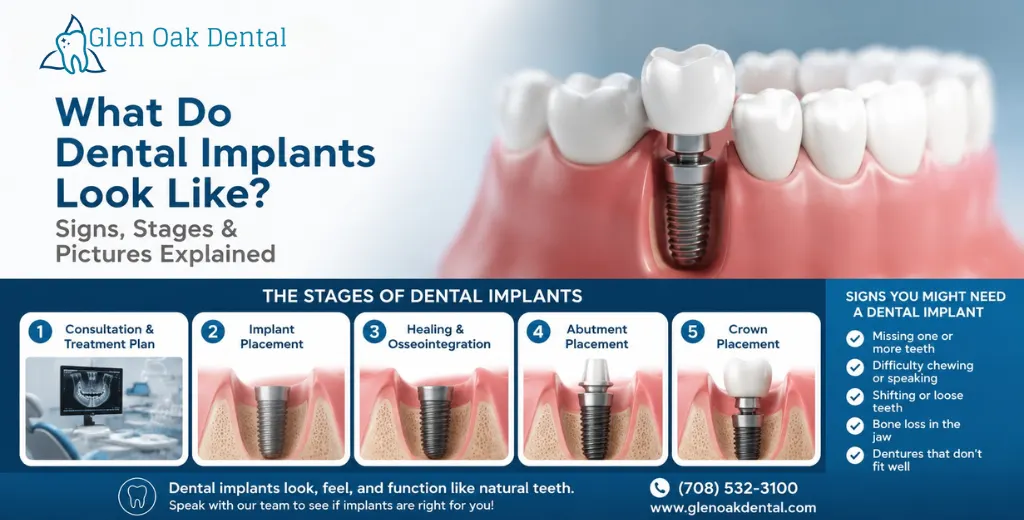
Dental implants look exactly like natural teeth once completed — a custom porcelain crown matched to your surrounding enamel. At Glen Oak Dental, every implant goes through a multi-stage process: a titanium post fuses with your jawbone, an abutment connects the components, and a final crown restores your smile seamlessly. When done correctly, no one can tell you have an implant.
What Do Dental Implants Look Like? A Complete Visual Guide for Canadian Patients
The Question Every Patient Really Asks
If you are reading this, you might be standing in front of a mirror, looking at a gap in your smile, or perhaps feeling the frustration of a bridge that just doesn’t feel “right” anymore. As a dentist, I hear the same question almost every day: “What do dental implants look like?”
Usually, what patients are really asking is: “Will people be able to tell I have a fake tooth?”
The short answer is no. When done correctly, a dental implant is indistinguishable from your natural teeth. But the journey to that perfect smile involves several stages where the “look” of the implant changes significantly. In this guide, I’m going to walk you through exactly what dental implants look like — from the titanium screw to the final porcelain crown — and explain the signs that you might be a candidate for this life-changing procedure in Canada.
Dealing with an urgent dental situation? Our emergency dentist team in North York offers same-day appointments — call 416-551-8480 right away.
The Anatomy: What Does a Dental Implant Actually Look Like?
To understand what they look like, we have to look at them in three distinct parts. If you saw a dental implant sitting on a table before surgery, it wouldn’t look like a tooth at all; it would look like a high-tech piece of engineering.
1. The Implant Post (The “Root”)
This is the part you never see once the process is complete. It looks like a small, metallic screw. Most are made of medical-grade titanium or zirconia. It is usually about 8 to 13 mm long. Its surface is often textured or treated to help your jawbone “grip” it — a process called osseointegration. The American Dental Association (ADA) recognises titanium as the gold-standard material for this reason.
2. The Abutment (The “Connector”)
Once the post is healed, we attach the abutment. This looks like a tiny metal peg or “stub” that sits just above the gum line. It serves as the bridge between the hidden post and the visible tooth. Material quality here directly affects both performance and appearance.
3. The Crown (The “Tooth”)
This is the only part the world sees. It is a custom-crafted porcelain or ceramic tooth. At Glen Oak Dental, we spend significant time matching the shade, translucency, and shape of this crown to your surrounding teeth so that it blends in perfectly. Our cosmetic dentistry team oversees every final restoration to ensure a seamless match.
| Component | Role | Visual Appearance |
|---|---|---|
| Titanium Post | Foundation (acts as root) | A small, threaded silver-coloured screw — never visible after healing. |
| Abutment | Connector between post and crown | A small metal or ceramic “stump” briefly visible at the gum line. |
| Porcelain Crown | The visible tooth | A custom-shaped tooth that matches your natural enamel — identical to a real tooth. |
The Stages of Appearance: A Visual Timeline
One of the biggest concerns patients have is how they will look during the treatment. You don’t walk into the clinic with a gap and walk out an hour later with a permanent tooth. It is a biological process — and understanding each stage helps set realistic expectations.
Stage 1: The Initial Surgery
Right after the post is placed, you won’t actually “see” the implant. The gum tissue is typically stitched over the post to protect it while it heals. You will still have a gap where the tooth was, but we can often provide a “flipper” (a temporary removable tooth) or a temporary bridge so you aren’t walking around with a visible space. Learn more about our dental bridges in North York as a temporary or permanent option during healing.
Stage 2: The Healing Phase (Osseointegration)
During the next 3 to 6 months, nothing visible changes on the outside. However, underneath the gums, your bone is fusing with the titanium — the process known as osseointegration. If you were to look at an X-ray during this stage, the implant would look like a solid silver pillar integrated into your jawbone. The Canadian Dental Association (CDA) confirms that proper osseointegration is the cornerstone of long-term implant success.
Stage 3: Abutment Placement
Once healed, we reveal the top of the implant and attach the abutment. For a week or two, you might see a small metal circle at the gum line — the “healing cap” or the abutment itself. It looks like a small silver bead resting on your gums. This stage is brief and temporary.
Stage 4: The Final Restoration
This is the “reveal” moment. We snap or screw the permanent crown onto the abutment. At this stage, the implant looks exactly like a natural tooth. Even if you looked closely with a magnifying glass, the way the “tooth” emerges from the gum line is designed to mimic nature perfectly. Our cosmetic dentistry team ensures the final crown is a seamless match to your natural smile.
Signs You Might Need Dental Implants
How do you know if it’s time to stop researching and start booking a consultation? Most patients in Ontario come in when they notice these specific “red flags” — signs that their current dental situation is no longer sustainable.
- The “Sunken” Face Look: When you lose teeth, the jawbone begins to resorb (shrink). This leads to a collapsed facial structure, making you look older than you are — a direct result of missing tooth roots that no longer stimulate the bone.
- Difficulty Chewing: If you are avoiding tough foods like steak or crisp apples, your current dental solution isn’t working. Implants restore full chewing power comparable to natural teeth.
- A Loose Bridge or Denture: If your traditional bridge is wobbling, the anchor teeth might be failing. Explore our dentures services or consider switching to implants for a permanent fix.
- An Infected or Cracked Tooth: When a tooth is “non-restorable,” an implant is often the most predictable long-term solution. Our root canal and tooth extraction specialists will help you evaluate all your options first.
- Teeth Visibly Shifting: Adjacent teeth naturally drift into the gap left by a missing tooth, disrupting your bite and alignment. Invisalign treatment may be needed alongside an implant in such cases.
If you’re noticing these signs, book a consultation at Glen Oak Dental to get a proper evaluation before bone loss advances further.
Types of Dental Implants and Their Visual Differences
Not every implant is a single screw. Depending on your clinical needs, the “look” and construction of your implant solution can vary significantly. Each type has distinct visual characteristics and candidacy requirements.
Single Tooth Implants
The most common type. It looks like one standalone tooth — the easiest to clean and the most natural-looking of all implant options. Visit our dedicated tooth implants page to learn about candidacy and the complete procedure in North York.
Implant-Supported Bridges
If you have three or four teeth missing in a row, we don’t necessarily need an implant for every tooth. We might place two implants and “bridge” a porcelain section between them. Visually, it looks like a continuous row of healthy teeth. Read more about our dental bridges in North York to understand this option in detail and compare it to single implants.
Full Mouth Dental Implants (All-on-4 / All-on-6)
For patients who have lost all their teeth, full mouth dental implants Canada providers often recommend a “fixed arch.” This looks like a perfect, full set of teeth. Instead of individual crowns, it’s one reinforced piece screwed into four or six implants. It eliminates the “bulkiness” of traditional dentures and restores the natural contour of your lips. Compare this to our dentures service to find the best fit for your lifestyle and budget.
The Investment: How Much Do Dental Implants Cost in Canada?
Cost is a major factor for every patient. When people ask how much dental implants cost in Canada, they are often surprised by the range — and the reasons behind it. Transparency is central to how we practise at Glen Oak Dental.
In Ontario, a single dental implant (including the post, abutment, and crown) typically ranges from $3,000 to $6,500. Why the price gap? It depends on several clinical factors:
- Bone Grafting: If you’ve been missing a tooth for a long time, you might need a bone graft to “bulk up” the site before implant placement can proceed safely.
- Material Choice: High-end zirconia crowns cost more than standard porcelain but offer superior aesthetics and are metal-free — ideal for patients with sensitivities.
- Location and Technology: A dental implant Toronto or dental implant Ontario specialist may have higher overhead, but also access to the latest 3D CT guided surgery technology that makes outcomes more predictable.
- Preparatory Procedures: Sinus lifts, extractions, or root canal therapy before implant placement add to the total.
When considering how much dental implants cost in your budget, think of it as a 25-year investment. While a bridge might need replacing every 7 to 10 years, a well-placed implant is designed to last a lifetime. Our team at Glen Oak Dental will go over your insurance coverage and financing options before treatment begins so there are no surprises.
Why You Shouldn’t Just “Google It” and Wait
I understand the temptation to keep researching. We all do it. But there is a point where “Dr. Google” becomes a risk. If you are experiencing any of the following, please stop reading and call a professional immediately:
- Severe pain or swelling in the jaw.
- A “pimple” on your gums — this is often a sign of an abscess that requires urgent attention.
- A tooth that feels loose or moves when you touch it with your tongue.
Waiting too long can result in significant bone loss, making the cost of dental implants much higher later because of the need for advanced reconstructive surgeries. Our emergency dentist in North York offers same-day appointments for urgent dental concerns — do not delay.
What the ADA, CDA, and Health Canada Say About Dental Implants
Three major health authorities in North America share a consistent, evidence-based position on dental implants: they are safe, clinically proven, and built for long-term success when placed by a qualified professional using certified materials.
American Dental Association — Implant Safety and Osseointegration
The American Dental Association (ADA) recognises dental implants as the gold standard for tooth replacement. Titanium implants achieve osseointegration — direct structural bonding with living bone — making them uniquely stable compared to bridges or dentures. Before proceeding, the ADA advises that a qualified professional assess bone quality, medical history, and individual suitability for each patient.
Canadian Dental Association — Evidence-Based Implant Standards
The Canadian Dental Association (CDA) supports dental implants as a reliable, evidence-based restorative solution. Thorough pre-surgical assessment — including bone density evaluation, 3D imaging, and medical history review — forms the foundation of every successful implant outcome. All implant procedures at Glen Oak Dental follow CDA clinical guidelines. The CDA also acknowledges that the long-term cost-effectiveness of implants typically surpasses alternatives when the full care lifecycle is factored in.
Health Canada — Biocompatibility and Device Certification
Health Canada classifies dental implants as Class III medical devices, subject to rigorous pre-market safety and efficacy review. Manufacturers must demonstrate biocompatibility — confirming that titanium or zirconia materials cause no adverse reactions in human tissue. Health Canada also oversees the sterilization standards and material certifications that every licensed dental clinic in Canada must maintain. Patients evaluating implant quotes should confirm their provider uses only Health Canada-approved devices.
The Canadian Advantage: Guided Surgery and Advanced Technology
In Canada, and specifically within the dental community at Glen Oak Dental, we use guided surgery technology. This means 3D CT scans plan the exact millimetre where the implant will go before we even touch your mouth — ensuring the final result doesn’t just “look” good, it functions perfectly with your bite.
How Guided Surgery Changes the Outcome
Advanced 3D CBCT scanning maps nerves, sinuses, and bone structure with sub-millimetre precision before surgery begins. This technology makes procedures minimally invasive and outcomes highly predictable. The diagnostic step adds to the initial dental implants cost — but it actively prevents far more expensive complications later. Skipping imaging to reduce upfront cost is a false economy that carries significant clinical risk.
Whether you are looking for a dental implant in Toronto or a full mouth restoration in Ontario, the standards set by the Canadian Dental Association (CDA) and Health Canada ensure you are receiving some of the best implant care in the world — aligned with evidence-based guidelines from the ADA.
For a full list of everything we offer, visit our dental services page. You can also explore our teeth whitening and Invisalign options to complement your implant restoration with a complete smile refresh.
Complete Oral Health: How Implants Fit Into Your Overall Dental Plan
Dental implants deliver the best outcomes when overall oral health is optimised before and after placement. At Glen Oak Dental, a full range of supporting services surrounds every implant case to maximise your result:
- Root canal therapy in North York — a tooth-saving alternative to extraction and implant in many cases
- Professional teeth cleaning in North York — essential before and after implant surgery for optimal gum health
- Dental bridges in North York — a fixed restoration alternative or complement for multi-tooth cases
- Dentures in North York — including implant-supported overdentures for full-arch tooth replacement
- Tooth extraction in North York — when extraction precedes implant placement, our team manages the full process
- Invisalign treatment in North York — corrects bite and alignment issues before or after implant placement
- Cosmetic dentistry in North York — completes your smile transformation alongside implant restoration
- Children’s and family dentistry — building prevention habits early in life that reduce the likelihood of tooth loss in adulthood
Frequently Asked Questions About Dental Implants
Final Thoughts: Restoring More Than Just a Tooth
A dental implant isn’t just about “what it looks like.” It’s about the confidence to order what you want at a restaurant. It’s about the security of knowing your teeth won’t slip when you’re giving a presentation or laughing with friends.
If you’ve been hiding your smile, remember that you aren’t alone. Millions of Canadians have made this choice. It is a predictable, safe, and visually stunning way to reclaim your oral health.
Ready to take the next step? Book your consultation at Glen Oak Dental today. Our experienced team in North York is here to answer every question and guide you through every stage of your implant journey.
Ready to Find Out What Dental Implants Can Do for Your Smile?
Glen Oak Dental — 2827 Bathurst Street, North York, ON M6B 3A4
Phone: 416-551-8480 | glenoakdental.ca
Led by Dr. Roya Khoshsar, D.D.S. — 15+ years of clinical experience in North York
Implant consultations available | Accepting new patients of all ages | Direct insurance billing
Whether you want a detailed visual walkthrough of the dental implant stages in North York, want to explore dental bridges or dentures as alternatives, need a root canal assessment before deciding on extraction, or are ready for teeth whitening to complement your new implant — our team delivers honest, transparent guidance at every step.
This guide was developed based on clinical protocols established by the Canadian Dental Association (CDA) and the American Dental Association (ADA). Health and safety standards referenced in this article follow guidelines from Health Canada. Information regarding the stages of dental implants and bone integration is rooted in standard oral surgery practices. Pricing data is based on current 2024–2026 market averages for dental services in Ontario and the Greater Toronto Area. All information is for informational purposes and should be confirmed with a clinical examination by a licensed dental professional.