
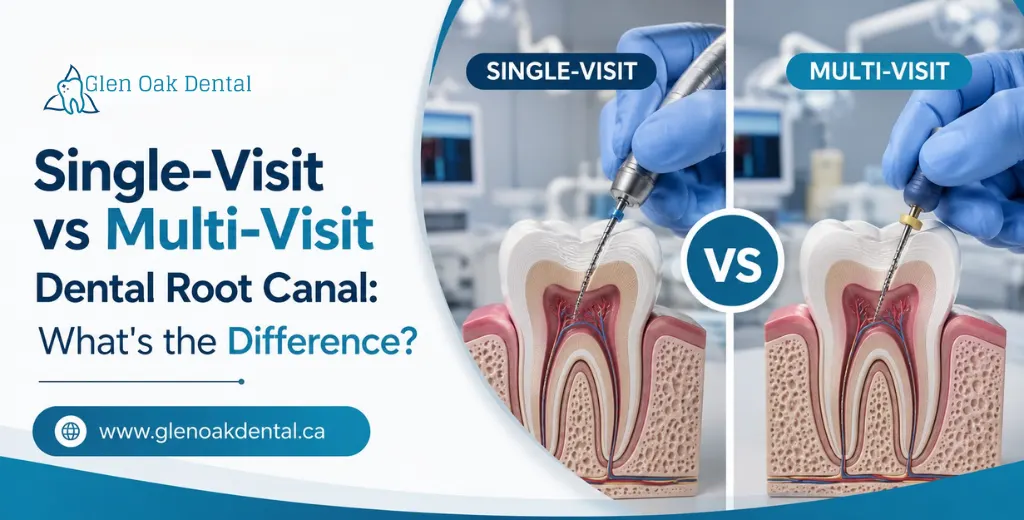
Whether your root canal is finished in one sitting or spread across two to three visits depends on your infection severity and canal anatomy — not convenience. At Glen Oak Dental, we assess every case individually before recommending single visit root canal treatment or multi visit root canal treatment, so you get the safest, most predictable outcome for your tooth.
Dental Root Canal
A patient asked me last week, “Doctor, can you just finish my root canal today? I don’t want to come back.” Fair question. I get it almost every time I diagnose a root canal.
Here’s the honest answer: sometimes I can finish it in one sitting. Sometimes I can’t. And the reason has nothing to do with how busy my schedule is — it comes down to your tooth, your infection, and what’s actually happening inside that root canal system.
In this guide, I’ll walk you through the real differences between single visit root canal treatment and multi visit root canal treatment, when each one applies, and how to know which path is right for you.
What Is a Root Canal, Quickly
Root canal therapy treats an infected or inflamed dental pulp — the soft tissue inside your tooth containing nerves and blood vessels — by removing the infected tissue, cleaning and shaping the canals, disinfecting the space, and sealing it.
Root canal therapy treats an infected or inflamed dental pulp — the soft tissue inside your tooth containing nerves and blood vessels. When decay, a crack, or trauma lets bacteria reach the pulp, it becomes infected. Left untreated, this can lead to a tooth abscess and eventually tooth loss.
During endodontic treatment, I remove the infected pulp, clean and shape the canals, disinfect the space, and seal it. That’s the short version. The question isn’t whether this happens — it’s whether it happens in one appointment or two.
Single Visit Root Canal: How It Works
A single visit root canal completes the entire process — cleaning, disinfection, and filling — in one appointment, usually 60 to 90 minutes, and works best for straightforward infections without significant swelling or drainage.
A single visit root canal, sometimes called one day root canal treatment or root canal in one sitting, completes the entire process — cleaning, disinfection, and filling — in a single appointment, usually 60 to 90 minutes.
This works well when:
- The infection is limited to the pulp, without a large abscess
- The tooth has a straightforward canal anatomy
- There’s no significant swelling or drainage present
- I’m confident the canal system can be fully cleaned and dried in one session
Modern rotary endodontics — mechanical instruments that shape canals faster and more consistently than hand files — has made single visit treatment far more predictable than it was a decade ago. An apex locator, a small device that measures canal length electronically, also helps me confirm I’ve reached the full depth of the root without extra x-rays or guesswork.
Advantages of Single Visit Treatment
- One appointment instead of two or three
- Less total time off work or school
- No temporary filling to worry about between visits
- Immediate relief for many patients
Multi Visit Root Canal: Why Some Cases Need It
A two-appointment root canal is recommended when there’s an active abscess, complex or curved canal anatomy, or a necrotic pulp — cases where medication needs time to work inside the canal before it’s permanently sealed.
A two-appointment root canal — or occasionally three — isn’t a sign of a “harder” case in a bad way. It’s simply what a responsible dentist recommends when the infection or anatomy calls for it.
I typically recommend multiple root canal sessions when:
- There’s an active abscess with pus or drainage that needs time to resolve
- The canal anatomy is curved, narrow, or unusually complex
- The tooth shows signs of necrotic pulp (the nerve tissue has died, which often carries a heavier bacterial load than an inflamed but living pulp)
- I want to place medication inside the canal between visits to fully calm the infection before sealing it permanently
Between visits, I place a temporary filling to protect the tooth. At the second appointment, once the canal disinfection is complete and the tooth is symptom-free, I finish shaping, fill the canals permanently, and prepare the tooth for a permanent crown placement.
Why Waiting Between Visits Can Be the Smarter Choice
Sealing a canal too early, while bacteria are still active, raises the risk of treatment failure. Giving an antimicrobial medication time to work between root canal appointments reduces that risk. This isn’t about caution for its own sake — it’s about giving the tooth the best possible long-term outcome.
Single Visit vs Multi Visit: Direct Comparison
Single visit root canals take 60 to 90 minutes with no temporary filling needed, while multi visit root canals involve two to three shorter appointments with a temporary filling placed between visits — both achieve similar healing time when done correctly.
| Factor | Single Visit | Multi Visit |
|---|---|---|
| Root canal treatment time | 60–90 minutes | 2–3 shorter visits |
| Best for | Simple, non-abscessed cases | Complex or infected cases |
| Root canal appointment length | Longer per visit | Shorter per visit |
| Temporary filling needed | No | Yes, between visits |
| Root canal healing time | Similar overall | Similar overall |
Does Sitting Number Affect Root Canal Success Rate?
Root canal success rate depends primarily on thorough cleaning and sealing of the canal system, not on the number of visits. Both single and multi-visit treatments can achieve excellent long-term outcomes when performed correctly.
This is the question patients care about most, and it’s a fair one. Research published through bodies like the American Dental Association (ADA) shows that root canal success rate depends primarily on how thoroughly the canal system is cleaned and sealed — not strictly on how many visits it took to get there. A well-executed single visit and a well-executed multi visit treatment can both achieve excellent long-term outcomes.
What matters more than visit count:
- Complete removal of infected tissue
- Proper canal disinfection
- A well-sealed filling that prevents bacteria from re-entering
- A timely permanent crown placement afterward, especially on back teeth
Retreatment risk goes up when any of these steps are rushed or incomplete — regardless of whether it happened in one visit or three.
Anterior vs Posterior Teeth Root Canal: Does Location Matter?
Front teeth usually have one straightforward canal, making them good single-visit candidates, while back molars often have two to four curved canals that may require more time or a second visit, especially with infection present.
Yes, actually. Front teeth (anterior) usually have a single, straightforward canal, which makes them good single-visit candidates. Back teeth (posterior), especially molars, often have two to four canals with more curvature — sometimes requiring more time, and occasionally a second visit, particularly if infection is present.
This is why I evaluate anterior vs posterior teeth root canal cases differently before promising a one-visit timeline.
Post-Treatment Pain: Is Single Sitting Root Canal Worse?
Post-treatment discomfort relates more to how inflamed or infected the tooth was beforehand than to the number of visits. Mild soreness for a few days is normal either way.
I hear this a lot: “Does single sitting root canal hurt more?” In my experience, and consistent with clinical literature, post-treatment discomfort relates more to how inflamed or infected the tooth was beforehand than to the number of visits. Mild soreness for a few days is normal either way and typically responds well to over-the-counter pain relief.
Endodontist vs General Dentist: Who Should Treat Your Case
General dentists comfortably treat straightforward root canals in one visit, while cases involving severe decay, cracked tooth infection, retreatment, or complex canal anatomy often benefit from referral to an endodontist specialist.
Many general dentists, myself included, comfortably treat straightforward root canals in one visit. For cases involving severe tooth decay, cracked tooth infection, retreatment, or unusually complex canal anatomy, referral to an endodontist — a specialist in root canal therapy — is often the better path. At Glen Oak Dental, I assess complexity at the diagnostic stage so you know upfront whether your case fits a general practice visit or benefits from specialist care.
Root Canal Cost Per Visit: A Quick Note
Total root canal cost is based on tooth type and overall complexity, not simply the number of appointments — a multi-visit treatment isn’t automatically more expensive than a single-visit one.
Total root canal cost is generally based on the tooth type and overall complexity, not simply the number of appointments. A multi-visit treatment isn’t automatically more expensive than a single-visit one — pricing reflects the clinical work involved, including any imaging, medication, and the final crown.
How I Decide: My Actual Clinical Process
- Diagnostic exam and x-ray to assess infection severity and canal anatomy
- Check for swelling, drainage, or abscess
- Evaluate pulp condition — inflamed pulp vs necrotic pulp
- Consider tooth location and root complexity
- Recommend single or multi visit root canal based on findings, not convenience
If your case is a strong single-visit candidate, I’ll tell you. If it isn’t, I’ll explain exactly why a second visit protects your tooth’s long-term health — because a rushed root canal that fails costs you more time, money, and discomfort than doing it right the first time.
What the ADA, CDA, and Health Canada Say About Root Canal Treatment
Major dental and health authorities recognize both single-visit and multi-visit root canal therapy as clinically valid approaches, with the right choice determined by diagnosis rather than patient preference alone.
American Dental Association — Evidence-Based Endodontic Standards
The American Dental Association recognizes root canal therapy as a safe, effective treatment for saving infected or damaged teeth, whether completed in a single visit or across multiple appointments based on clinical need.
Canadian Dental Association — Patient-Centred Endodontic Care
The Canadian Dental Association (CDA) supports individualized treatment planning for root canal therapy, emphasising that visit count should reflect infection severity and canal complexity rather than a fixed protocol.
Health Canada — Safety and Regulation of Endodontic Materials
Health Canada regulates the materials used in root canal therapy, including gutta-percha filling materials and canal disinfection agents, under the Medical Devices Regulations to ensure patient safety across licensed Canadian dental clinics.
Complete Dental Care: How Root Canal Treatment Fits Into Your Dental Plan
A healthy, pain-free tooth is the foundation for every other aspect of your oral health. At Glen Oak Dental, we offer a full range of supporting services alongside root canal therapy:
- Emergency dentistry in North York — same-day care for severe tooth pain, swelling, or a suspected abscess.
- Dental bridges in North York — restoring adjacent teeth affected by long-standing decay or infection.
- Tooth implants in North York — an alternative when a tooth cannot be saved by root canal therapy.
- Professional teeth cleaning in North York — essential for preventing future decay and pulp infection.
- Tooth extraction in North York — when severe damage means the tooth cannot be treated with a root canal.
- Children’s and family dentistry in North York — early detection of decay to help prevent pulp infections.
- Cosmetic dentistry in North York — restoring the appearance of a tooth after root canal and crown placement.
Conclusion
Single visit and multi visit root canal treatments are both effective, clinically validated ways to save an infected tooth — the right choice simply depends on your infection severity, canal anatomy, and overall tooth condition. Neither approach is inherently better; what matters is thorough cleaning, proper disinfection, and a well-sealed final restoration.
Whether your case is a straightforward single-sitting treatment or needs the extra care of a second appointment, the best first step is a proper diagnostic exam. At Glen Oak Dental, we assess every root canal case individually so your treatment plan matches your actual clinical needs.
Frequently Asked Questions
Ready to Treat Your Tooth Pain in North York?
Waiting on a suspected root canal only gives infection more time to spread. Whether your case turns out to be a single visit or a multi visit treatment, the best next step is a proper diagnostic exam with a dental team you can trust.
Book Your Root Canal Consultation in North York
Glen Oak Dental — 2827 Bathurst Street, North York, ON M6B 3A4
Phone: 416-551-8480 | glenoakdental.ca
Led by Dr. Roya Khoshsar, D.D.S. — 15+ years of clinical experience in North York
Root canal consultations available | Accepting new patients of all ages | Direct insurance billing
Whether you need a same-day root canal assessment, are dealing with a dental abscess, or want to complete your smile with a permanent crown afterward — our team delivers honest, transparent guidance at every step.
This article is based on established clinical guidelines for endodontic treatment and reflects principles supported by the American Dental Association (ADA), the Canadian Dental Association (CDA), and Health Canada’s public oral health resources. It was written and structured following current SEO and AI content optimization best practices for 2026, with all clinical claims kept conservative and consistent with mainstream dental guidance.