
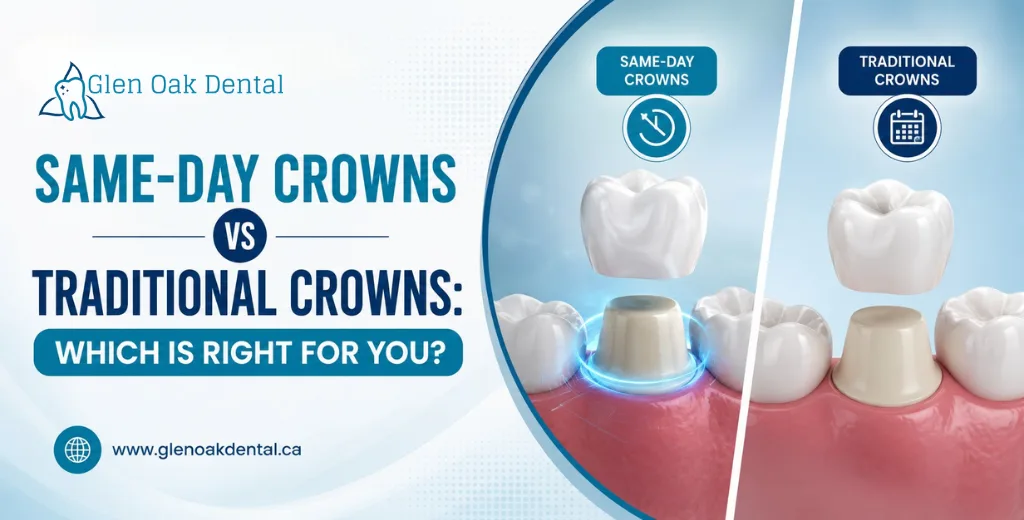
Same-day crowns are milled in-office in a single visit using CAD/CAM technology, while traditional crowns are made by a dental lab over two visits. Both offer similar strength and lifespan when made from the same material — the right choice depends on the tooth, the material, and your schedule. At Glen Oak Dental, we help you choose the crown option that fits your case.
Same-Day Crowns vs Traditional Crowns
You chipped a tooth, or your dentist just told you that you need a crown. Now you’re staring at two options: get it done today, or come back in a few weeks. Which one actually makes sense?
I get this question almost every week in my practice. Patients want a straight answer, not a sales pitch. So let’s break down same-day crowns vs traditional crowns honestly, based on how each one actually works, what they cost, and how long they last.
By the end of this article, you’ll know exactly which option fits your situation, your budget, and your schedule.
What Is a Dental Crown, Exactly?
A dental crown is a cap that covers a damaged or weakened tooth, restoring strength, shape, and function so you can bite and chew normally again.
A dental crown is a cap that covers a damaged or weakened tooth. Think of it as a helmet for a tooth that’s cracked, heavily decayed, or has just had a root canal. Crowns restore strength, shape, and function so you can bite and chew normally again.
There are two ways to get one made: same-day crowns using CAD/CAM technology, or traditional dental crowns made in an outside dental lab. Both work well. They just get you there differently.
Same-Day Dental Crowns: How They Work
Same-day crowns, often called CEREC crowns, are milled right in the dental office using CAD/CAM dental technology. Here’s the basic flow:
Your dentist takes digital impressions of your tooth using an intraoral scanner. No goopy trays, no biting into a putty tray for two minutes. Software designs the crown on a screen, then a milling machine carves it from a solid block of ceramic, usually zirconia or a similar material, right there in the office.
You walk in with a damaged tooth and walk out a few hours later with a finished crown. One visit. No temporary crown needed.
Why Patients Like Single-Visit Crowns
The obvious win is convenience. If you’re busy, live far from the clinic, or just hate wearing a temporary crown for two to three weeks, single-visit crowns solve that problem outright.
There’s also less risk of the temporary crown coming loose or trapping food, which is genuinely one of the most annoying parts of the traditional process.
Traditional Dental Crowns: How They Work
Traditional crowns follow a two-visit crown process. At the first appointment, your dentist preps the tooth and takes an impression, either digital or a physical mold. That impression goes to a dental lab, where technicians hand-craft the crown using materials like porcelain, zirconia, or porcelain-fused-to-metal (PFM).
You leave with a temporary crown to protect the tooth while you wait, usually one to three weeks. At your second visit, the dentist removes the temporary and cements the permanent crown in place.
Why Some Dentists Still Prefer This Route
Lab-made crowns benefit from technicians who specialize in aesthetics, especially for front teeth where color layering and translucency matter. For complex cases, or when a crown needs to match a very specific shade, the extra time can produce a slightly more refined result.
Same-Day Crown Cost vs Traditional Crown Cost
Same-day and traditional crown costs are similar overall — pricing is driven mainly by the crown material and location, not the manufacturing method.
This is where a lot of confusion comes from, so let’s keep it simple.
Same-day crowns and traditional crowns are usually priced similarly. The cost depends more on the material used and your location than on whether it’s made in-office or in a lab. Zirconia and porcelain crowns tend to cost more than PFM crowns regardless of which process you choose.
Your dental insurance typically covers crowns the same way in both cases, though it’s always worth confirming with your provider beforehand, since coverage percentages vary by plan.
Crown Material Comparison: Zirconia, Porcelain, and PFM
Material matters more than method when it comes to durability and appearance.
Zirconia is extremely strong and holds up well under chewing forces, making it a popular choice for back teeth. Porcelain offers the most natural, tooth-like appearance, which is why it’s often chosen for front teeth. PFM (porcelain-fused-to-metal) combines a metal base with a porcelain layer, giving you strength with a reasonably natural look, though it can sometimes show a dark line near the gum over time.
Both same-day and traditional crown processes can use any of these materials, so this isn’t really a same-day-versus-traditional decision. It’s a material decision you’ll make with your dentist based on which tooth needs the crown.
Crown Lifespan and Durability
According to the American Dental Association, dental crowns generally last between 5 and 15 years, often longer with good oral hygiene and regular checkups.
According to the American Dental Association (ADA), dental crowns generally last between 5 and 15 years, and often longer with good oral hygiene and regular checkups. The Canadian Dental Association (CDA) notes similar ranges, with lifespan depending heavily on material choice, bite pressure, and how well you maintain the crown.
Here’s the honest truth: a well-made same-day crown and a well-made lab crown, using the same material, tend to perform similarly over time. The manufacturing method isn’t the main factor in longevity. Your oral hygiene, grinding habits, and regular professional teeth cleaning visits matter far more.
Same-Day Crowns Pros and Cons
Pros:
- One appointment instead of two
- No temporary crown or the issues that come with it
- Digital impressions are more comfortable than traditional molds
- Fewer chances of the tooth shifting between visits
Cons:
- Not every dental office has CAD/CAM equipment
- Slightly less flexibility for complex aesthetic cases
- Milled ceramic blocks have fewer shading options than hand-layered porcelain
Traditional crown pros:
- Lab technicians can fine-tune shade and shape for a natural look
- Well-suited for complex bite or cosmetic cases
Traditional crown cons:
- Two visits required
- Temporary crown period, with a small risk of sensitivity or the temporary loosening
- Longer overall timeline
How Long Do Dental Crowns Take?
Same-day crowns take roughly 1.5 to 3 hours in a single visit, while traditional crowns take two shorter visits spread across one to three weeks.
Same-day crowns take roughly 1.5 to 3 hours from prep to placement, all in a single visit. Traditional crowns take two shorter visits spread across one to three weeks, with lab turnaround time being the main variable.
If your schedule is tight, that difference matters. If you’re not in a rush, it likely won’t change your decision much.
Which Option Does Your Dentist Recommend?
Here’s my honest, first-person take. I recommend same-day crowns for most back teeth, routine restorations, and patients who value convenience. I lean toward traditional lab-made crowns when a case involves a front tooth with specific shading needs, or a more complex bite adjustment.
Neither option is “better” across the board. The right choice depends on the tooth, the material, and your schedule. At Glen Oak Dental, we walk through both options with patients before deciding, because the best crown is the one that fits your specific situation.
Complete Dental Care: How Crowns Fit Into Your Treatment Plan
A crown is often just one part of a larger restorative plan. At Glen Oak Dental, crowns commonly work alongside:
- Dental bridges in North York — for replacing missing teeth adjacent to a crowned tooth.
- Tooth implants in North York — often topped with a crown when a tooth cannot be saved.
- Emergency dentistry in North York — for a lost or broken crown that needs same-day attention.
- Cosmetic dentistry in North York — for shade-matching and smile-focused crown placement.
Frequently Asked Questions
Ready to Discuss Your Crown Options?
Whether you’re a candidate for a same-day crown or need the extra precision of a lab-made crown, the best next step is a proper consultation.
Book Your Crown Consultation in North York
Glen Oak Dental — 2827 Bathurst Street, North York, ON M6B 3A4
Phone: 416-551-8480 | glenoakdental.ca
Led by Dr. Roya Khoshsar, D.D.S. — 15+ years of clinical experience in North York
Same-day and lab-made crown options available | Accepting new patients of all ages | Direct insurance billing
This article is based on established clinical dental guidelines and was reviewed using trusted sources, including the American Dental Association (ADA) and the Canadian Dental Association (CDA), alongside general oral health guidance from Health Canada. Content was written following current SEO, AEO, and GEO best practices to ensure accuracy, clarity, and genuine value for readers researching their crown options.