
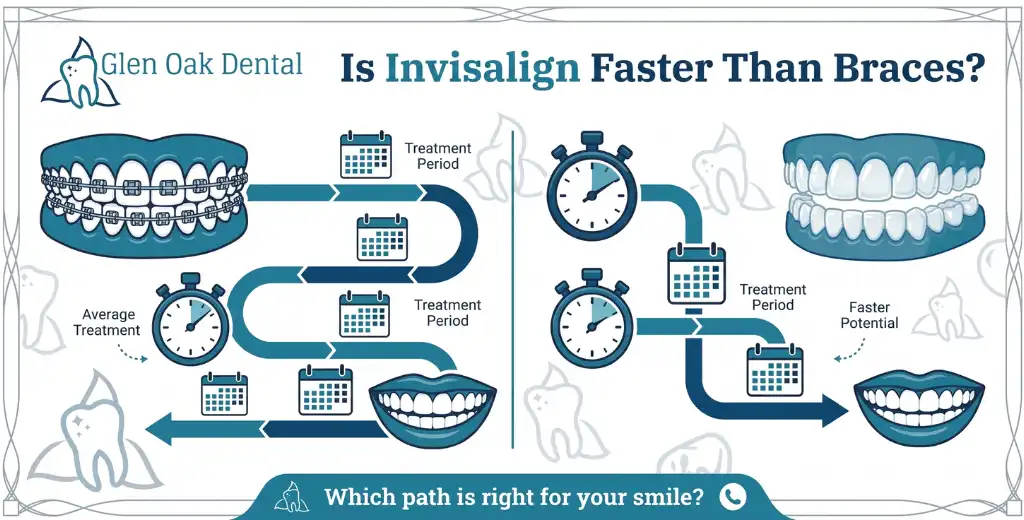
Is Invisalign Faster Than Braces? Here’s What the Evidence Actually Shows
I get this question at nearly every orthodontic consultation I run. A patient sits down, pulls up their phone, and asks: “I’ve read Invisalign is faster — is that actually true?”
The answer is more nuanced than most dental websites will tell you. Invisalign can be faster — sometimes significantly so. But it can also take just as long, or longer, depending on your specific case. Marketing claims from aligner companies don’t always match clinical reality.
In this guide, I’ll walk you through the actual evidence behind both orthodontic treatment options — their timelines, the science of how each moves teeth, which cases suit which treatment, and exactly what determines whether Invisalign or traditional braces will get you to a straighter smile faster. By the end, you’ll have everything you need to make a confident, informed decision.
How Long Does Orthodontic Treatment Actually Take?
Orthodontic treatment duration is not a fixed number — it’s a range shaped by the severity of your misalignment, your biological response to tooth movement, and how well you follow the treatment plan your dentist sets out. That said, clear patterns do emerge from clinical practice.
Here’s what the real-world data looks like:
- Invisalign treatment duration — mild cases: 6–12 months
- Invisalign treatment duration — moderate cases: 12–18 months
- Traditional metal braces — average: 18–24 months
- Traditional braces — complex cases: Up to 36 months in severe scenarios
- Minimum daily aligner wear required: 20–22 hours per day without exception
- Standard aligner change frequency: Every 7–14 days, as directed by your dentist
These aren’t marketing estimates — they reflect published orthodontic literature and what I observe in clinical practice. The key insight is that the gap between Invisalign and braces narrows significantly as case complexity increases. For a patient with minor dental crowding or small spacing gaps, Invisalign can genuinely finish months ahead of braces. For a patient with a significant overbite or underbite, that speed advantage largely disappears.
Why Is Invisalign Faster Than Braces? The Real Reasons
Invisalign’s speed advantage — when it exists — comes from a combination of advanced material science, digital treatment planning, and a fundamentally different approach to applying orthodontic force. Understanding this helps you see both why it can be faster and where its limits lie.
1. ClinCheck digital treatment planning eliminates guesswork
Every Invisalign treatment begins with a full 3D digital scan of your teeth. Align Technology’s ClinCheck software then maps your complete tooth movement journey — from your current position to the final result — before a single aligner is manufactured. This means the entire orthodontic treatment path is engineered in advance, not adjusted appointment by appointment as it is with traditional braces.
The result: fewer surprises, fewer course corrections mid-treatment, and a more efficient progression from start to finish.
2. SmartTrack aligner material applies consistent, targeted force
Invisalign’s proprietary SmartTrack material is clinically designed to apply gentle, constant force to precisely targeted teeth at each stage of teeth straightening. Unlike a metal archwire — which exerts a single continuous force across all teeth simultaneously — each aligner works on a specific set of movements. This staged, targeted approach reduces unnecessary pressure and allows the periodontal ligament to respond more predictably, which supports faster tooth movement in straightforward cases.
3. Aligner changes can happen as often as every 7–10 days
With traditional braces, your next wire adjustment happens every 4–6 weeks at a scheduled clinic appointment. With Invisalign, many patients — with dentist approval — can switch to their next aligner tray every 7–10 days. That compressed progression adds up meaningfully over the course of a full orthodontic treatment timeline.
4. No wire breakages or bracket emergencies delaying progress
Emergency appointments for broken brackets or popped wires are a genuine source of treatment delay in traditional brace patients. Clear aligners eliminate this risk entirely. Every week your treatment isn’t delayed is a week closer to completing teeth straightening on schedule.
5. Fewer mandatory clinic visits keep the timeline moving
Invisalign patients typically attend check-ups every 6–10 weeks rather than the 4–6 week tightening cycle of braces. Fewer required appointments means fewer scheduling gaps — which, for busy adults, is a practical contributor to staying on track.
That said, none of these advantages matter if the aligners aren’t being worn. The single biggest variable in Invisalign treatment speed is consistent patient compliance. Wearing aligners for 18 hours instead of 22 — even occasionally — slows tooth movement, causes teeth to lose their tracking, and can add weeks or months to total treatment time. For more detail on candidacy and the process, visit our Invisalign treatment page.
Is Braces Faster Than Invisalign? Yes — For These Cases
This is the part that Invisalign marketing tends to gloss over. For a significant subset of patients, traditional metal braces are faster, more precise, and more effective than clear aligners — regardless of how well the patient complies with treatment.
Traditional braces give the dentist or orthodontist direct, continuous control over tooth movement using metal brackets bonded to each tooth and an archwire threaded through them. This direct mechanical connection allows for complex multi-directional tooth movements that clear aligners struggle to replicate reliably.
Cases where traditional braces are typically faster than Invisalign:
- Severe dental crowding — when multiple teeth require significant repositioning across the arch
- Significant overbite, underbite, or crossbite — skeletal bite corrections involving jaw positioning
- Tooth rotation beyond 20 degrees — Invisalign has documented limitations with high-rotation cases
- Vertical tooth movement — intrusion (pushing teeth upward) and extrusion (drawing teeth downward) are particularly challenging for aligners
- Adolescent patients with lower compliance likelihood — a fixed appliance removes the variable of whether the patient is actually wearing it
- Cases requiring multiple simultaneous arch corrections — braces handle this more predictably
Attempting to force a complex orthodontic case through Invisalign when braces are the more appropriate tool doesn’t just risk slower results — it risks poor tooth movement that requires refinement aligners, backtracking, or ultimately switching to braces partway through. Getting the right tool from the start is always faster.
Invisalign vs. Braces: Full Side-by-Side Comparison
Here is a comprehensive comparison of Invisalign clear aligners versus traditional metal braces across every factor that influences your orthodontic treatment decision.
| Category | Invisalign (Clear Aligners) | Traditional Metal Braces |
|---|---|---|
| Treatment Duration | 6–18 months (mild/moderate) | 18–24 months (average) |
| Appearance | Nearly invisible — discreet orthodontics | Visible metal brackets and archwires |
| Removable | Yes — remove to eat, drink, brush, floss | No — fixed orthodontic appliance |
| Patient Compliance | Critical — 22 hours/day non-negotiable | Moderate — dietary restrictions only |
| Complex Cases | Limited — mild to moderate cases | Effective across all severity levels |
| Comfort | Smooth plastic — less soft tissue irritation | Brackets can irritate cheeks and gums |
| Appointment Frequency | Every 6–10 weeks | Every 4–6 weeks for wire adjustments |
| Oral Hygiene | Easy — brush and floss normally | More effort — cleaning around brackets |
| Diet Restrictions | None — remove aligners to eat anything | Avoid hard, sticky, and chewy foods |
| Emergency Appointments | Rare — no wires or brackets to break | More common — broken brackets delay progress |
| Best Suited For | Adults and responsible teens; mild/moderate cases | All ages; complex crowding, bite, rotation |
How Much Faster Is Invisalign Than Braces? A Realistic Look
For mild to moderate cases, clinical evidence supports Invisalign being approximately 3 to 6 months faster than traditional braces — sometimes more. A patient correcting minor dental crowding or small spacing gaps might complete Invisalign in 6–9 months, while braces would take 12–15 months for the equivalent correction.
For moderate cases with multiple alignment issues, the gap narrows. Expect Invisalign to finish 2–4 months ahead of braces, if at all. For complex cases requiring bite correction or significant rotation, the timeline difference can reverse entirely — braces may finish first.
The honest summary: Invisalign is faster when it’s the right tool for the job. Choosing it for the wrong case doesn’t create speed — it creates complications.
Five Factors That Determine Your Orthodontic Treatment Speed
Regardless of whether you choose Invisalign or traditional braces, these five variables have the greatest influence on how long your teeth straightening journey actually takes.
1. Severity and type of misalignment
This is the most important factor. Minor dental crowding or small gaps respond quickly to either treatment. Severe crowding, large overbite or underbite corrections, or teeth requiring significant rotation add months to any orthodontic timeline — regardless of which system you use. Your dentist’s assessment of this during a clinical examination and digital scan review is the most reliable indicator of how long you’ll be in treatment.
2. Patient compliance — especially with Invisalign
Braces work continuously because they’re fixed to your teeth. Invisalign only works when you wear the aligners. Every hour your aligners sit on the bathroom counter instead of in your mouth is an hour of zero tooth movement. Patients who treat 22 hours as a firm minimum — not a casual guideline — complete treatment on schedule. Those who don’t often need additional refinement aligner trays, which extend treatment by weeks or months. Compliance is entirely within your control, and it has more impact on Invisalign treatment duration than almost any other factor.
3. Patient age and bone metabolism
Teeth move through bone, and younger bone responds faster. Adolescent patients tend to experience quicker tooth movement because their alveolar bone is less dense and their periodontal ligament is more elastic. Adult patients — particularly those over 40 — often see slightly slower tooth movement for equivalent corrections. This doesn’t make adult orthodontic treatment less effective; it simply means realistic timelines may be at the longer end of the published ranges. Our family and children’s dentistry team can advise on the ideal age to begin orthodontic assessment for younger patients.
4. Consistency of dental check-up attendance
Regular orthodontic check-ups are not optional extras — they’re built into the treatment plan. For braces patients, missed adjustment appointments mean missed wire tightening, which means teeth that aren’t progressing. For Invisalign patients, check-ins allow your dentist to confirm your teeth are tracking correctly against the ClinCheck plan. Catching a tracking issue at week six is fixable; catching it at week twenty means backtracking. Staying current with your dental care and check-up schedule throughout treatment keeps your progress on course.
5. Individual biological response to orthodontic force
Some patients’ teeth move predictably and quickly in response to applied force — orthodontists call these patients “good movers.” Others, due to variations in bone density, systemic health conditions, certain medications (particularly bisphosphonates used for osteoporosis), or simply individual physiology, respond more slowly. This is genuinely difficult to predict with precision before treatment begins, which is why the ranges published in clinical literature are exactly that — ranges. A thorough pre-treatment assessment, including digital scans and panoramic X-rays, gives your dentist the best available data to set realistic expectations.
Who Should Choose Invisalign — and Who Shouldn’t
Invisalign is an outstanding orthodontic option for the right patient. Understanding who that is helps set clear expectations before you commit to either treatment.
Invisalign is typically the best choice for patients who:
- Have mild to moderate dental crowding, spacing, or minor bite discrepancies
- Are adults or highly motivated teenagers who will genuinely maintain 22-hour daily wear
- Work in professional or client-facing environments where discreet orthodontics is a priority
- Play contact sports or wind instruments where fixed brackets create practical challenges
- Want the convenience of removing aligners for meals, brushing, and flossing without restrictions
- Have previously had braces and want to correct minor relapse without returning to metal brackets
Traditional braces are typically the better choice for patients who:
- Have severe dental crowding requiring significant arch expansion or tooth extraction
- Need significant overbite, underbite, or crossbite correction
- Have teeth with high-degree rotations that exceed aligner capacity
- Are adolescents who may not reliably maintain aligner wear throughout the day
- Have complex cases involving multiple simultaneous corrections across both arches
- Prefer a treatment that works continuously without any compliance responsibility
Some patients benefit from combining both — beginning with traditional braces to handle the complex biomechanical work, then transitioning to Invisalign for finishing touches. This hybrid approach can actually be faster overall than attempting to complete the full correction with one system. Visit our cosmetic dentistry page to see how orthodontic treatment can work alongside other aesthetic improvements to achieve your ideal result.
The Retention Phase: What Comes After Active Treatment
One of the most important — and most frequently overlooked — aspects of orthodontic treatment is what happens after your braces come off or your final aligner is worn. Active treatment straightens your teeth. The retention phase keeps them there.
Whether you’ve had Invisalign or traditional braces, teeth have a biological memory of their original position. Without long-term retainer wear, they will drift back — sometimes significantly, and sometimes rapidly in the months immediately after treatment ends. The Canadian Dental Association (CDA) recommends ongoing retainer use following all orthodontic treatment, with most patients wearing retainers nightly for years — or indefinitely.
At Glen Oak Dental
We discuss retainers at the very first consultation, not the last. A patient who completes a perfect Invisalign treatment in 12 months but neglects their retainer may find themselves back in our chair two years later with teeth that have partially relapsed. The retention phase is not optional — it’s the part that makes the treatment permanent.
If your teeth have already shifted after previous orthodontic treatment, ask about our Invisalign options for relapse correction. In many of these cases, a shorter course of clear aligner treatment — sometimes as few as 3–6 months — can restore your original result.
When to Stop Researching and Book a Consultation
Online research is a useful starting point, but it can’t tell you which orthodontic treatment is right for your specific bite, bone structure, and lifestyle. If any of the following apply to you, it’s time to book an in-person assessment rather than continue comparing articles.
- You have visible dental crowding, overlapping teeth, or gaps that concern you
- You’ve wanted orthodontic treatment for years but haven’t taken the first step
- You’re in a professional environment and want a discreet teeth-straightening option that won’t affect your appearance
- Your child or teenager is showing early bite or alignment issues — the earlier an assessment happens, the more treatment options are available
- You’ve noticed jaw pain, frequent headaches, or uneven tooth wear — these can be signs of a bite misalignment that orthodontic treatment addresses
- You completed orthodontic treatment in the past but your teeth have shifted due to inconsistent retainer wear
A proper consultation includes a clinical exam, digital scans, and a frank conversation about what’s realistic for your case. If you’re dealing with dental pain alongside alignment concerns, our emergency dentistry team can address any urgent issues first so they don’t interfere with the start of your orthodontic treatment.
What Health Canada, the CDA, and the ADA Say About Orthodontic Treatment
Orthodontic treatment — whether through Invisalign clear aligners or traditional metal braces — is a clinically validated, safe, and effective intervention for dental misalignment when performed by a licensed dental professional. All three major dental and health authorities are in alignment on this.
Health Canada regulates orthodontic appliances — including clear aligner systems — as Class II medical devices, meaning they’ve met safety and effectiveness standards before being approved for use in Canada. Both Invisalign and traditional braces are fully approved for clinical use.
The Canadian Dental Association (CDA) emphasises that correcting misalignment is about far more than aesthetics. A properly aligned bite reduces the risk of uneven tooth wear, makes oral hygiene more effective (straight teeth are easier to clean, reducing the risk of tooth decay and gum disease), and can relieve jaw strain that contributes to temporomandibular joint discomfort.
The American Dental Association (ADA) confirms that modern Invisalign technology — particularly advances in SmartTrack material and ClinCheck digital treatment planning — has expanded the range of cases clear aligners can treat effectively. Continuous improvements in aligner science mean that cases that were not suitable for Invisalign five years ago may now be treatable. This is precisely why a current assessment with a qualified dental professional matters more than general information you find online.
Frequently Asked Questions: Is Invisalign Faster Than Braces?
This article was written by a dental professional at Glen Oak Dental and is grounded in clinical orthodontic practice and published research. Sources reviewed include the American Dental Association (ADA), the Canadian Dental Association (CDA), and Health Canada. All treatment timelines reflect published clinical literature and real-world observation from dental practice.
Not Sure Which Orthodontic Treatment Is Right for You? Start With a Consultation at Glen Oak Dental.
Glen Oak Dental — 2827 Bathurst Street, North York, ON M6B 3A4
Phone: 416-551-8480 | glenoakdental.ca
Led by Dr. Roya Khoshsar, D.D.S. — 15+ years of clinical experience in restorative and orthodontic dentistry, North York
We review your digital scans, bite relationship, and clinical history to give you an honest recommendation — Invisalign, braces, or a combination approach. No guesswork, no pressure, and no one-size-fits-all advice. Just a clear picture of your options and what each one means for your timeline, your comfort, and your long-term result.