
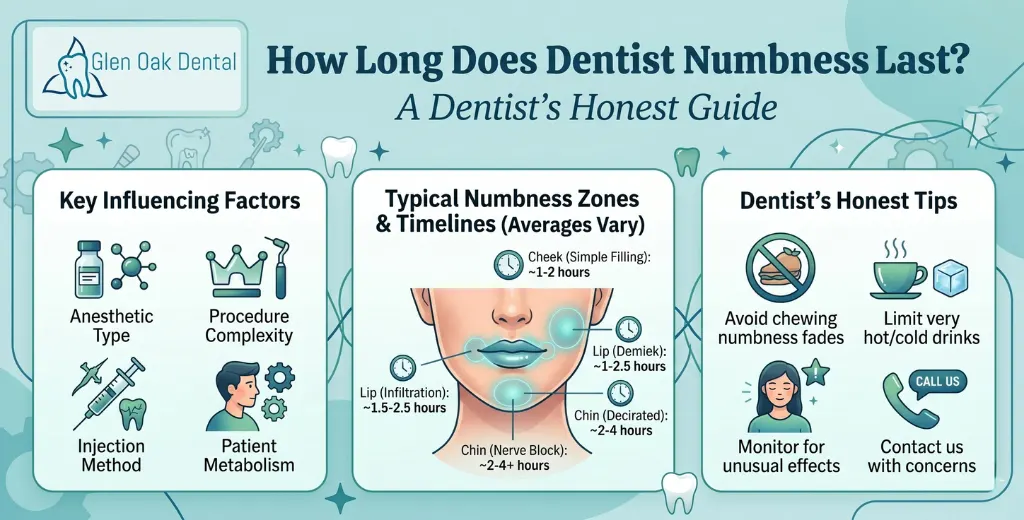
Dental numbness typically lasts between 1.5 and 5 hours after your appointment. Most patients regain full feeling within 2 to 3 hours. The type of local anaesthetic, injection location, dose, and your body chemistry all affect the duration. At Glen Oak Dental in North York, we walk every patient through what to expect before, during, and after treatment.
How Long Does Dentist Numbness Last? A Dentist’s Honest Guide
You walk out of the dentist’s chair, appointment done, and you notice it right away — your lip feels three times its normal size, your cheek is oddly puffy, and smiling feels a little ridiculous. You are not alone. One of the most common questions patients ask me after treatment is: “How long does dentist numbness last?”
The honest answer depends on a few things, and I want to walk you through all of them. Whether you just had a routine filling, a tooth extraction, or root canal therapy, this guide covers exactly what to expect — and when to stop worrying.
How Long Does Dentist Numbness Last? (The Direct Answer)
Dental numbness typically lasts between 1.5 and 5 hours after your appointment. Most patients regain full feeling within 2 to 3 hours. The type of local anaesthetic, injection site, dose amount, and your body chemistry all play a role in how long the numbness stays.
Your lips, cheeks, and tongue tend to stay numb longer than the tooth and bone itself. So even if the procedure is over and the tooth feels fine, your lip might still feel thick for another hour or two. That is completely normal.
What Makes You Numb in the First Place?
Before getting into timing, it helps to understand what actually happens. When your dentist prepares to treat a tooth, they inject a local anaesthetic — most commonly lidocaine or articaine — near the nerve that supplies feeling to that part of your mouth.
The medication temporarily blocks electrical signals along the nerve. This is why you feel no pain during treatment. It does not affect your awareness, muscle movement (in most cases), or your ability to breathe. It simply switches off feeling in one specific area.
Once your body processes the drug and clears it from the tissue, sensation returns gradually on its own. You cannot rush this process meaningfully, though I will share some practical tips a little further down.
Many patients also ask how long does local anesthesia last in mouth specifically — and the short answer is that the drug stays active in your oral tissues until your body metabolises and clears it, which is why timing varies so much from person to person.
How Long Do Numbing Shots from the Dentist Last? (By Anaesthetic Type)
The anaesthetic your dentist chose plays the biggest role in how long your mouth stays numb. Here is a clear breakdown of how long numbing shots from the dentist last for each type.
Lidocaine (Novocaine) with Epinephrine — Most Widely Used
Dentists across Canada use lidocaine with a small amount of epinephrine as their standard choice. You may hear this called novocaine, though true novocaine (procaine) is rarely used today — lidocaine has largely replaced it. Epinephrine tightens nearby blood vessels, which slows how fast your body absorbs the drug. You can expect 2 to 3 hours of soft tissue numbness and roughly 60 to 90 minutes of tooth and bone numbness.
Articaine — Strong Bone Penetration
Articaine moves through bone more effectively than lidocaine. Dentists often choose it for lower molar work. The numbness lasts roughly 2 to 3 hours — similar to lidocaine with epinephrine — but the coverage tends to be more thorough.
Bupivacaine — Long-Acting Option
Dentists use bupivacaine after more involved procedures like dental implant placement or surgical extractions. This drug works for 4 to 8 hours, which gives you time to get home and settled before any post-procedure discomfort begins.
Mepivacaine — Epinephrine-Free
Some patients need an anaesthetic without epinephrine — for example, those with certain heart conditions. Mepivacaine fits this need well. It lasts approximately 1.5 to 3 hours, slightly less than epinephrine-containing options.
How Long Does Dental Numbing Last by Procedure Type?
Where the dentist places the injection matters just as much as the drug itself. Here is what to expect after each common dental procedure — and how long those numbing shots from the dentist last in each case.
After a Routine Filling
For upper teeth, dentists place the injection close to the root tip of that specific tooth. The numbness fades relatively quickly — usually within 1.5 to 2 hours. Lower tooth fillings need a nerve block and tend to last 2 to 4 hours. Patients often ask specifically how long does numbness last after a cavity filling or how long does numbness last after a dental filling — and this 2 to 4 hour window covers the vast majority of cases.
Want to know more about what a filling feels like? Visit our general dentistry page at Glen Oak Dental, where we use tooth-coloured composite materials for natural-looking results.
After a Tooth Extraction
Lower molar removals need an inferior alveolar nerve block, which numbs the entire lower half of the jaw — including the chin and lower lip. Expect numbness for 3 to 5 hours. Surgical extractions may need bupivacaine, which can push that to 6 to 8 hours. Our team gives detailed recovery guidance after every tooth extraction.
After Root Canal Therapy
Root canal treatment needs deep, steady numbness throughout the whole procedure. Most patients find that numbness from root canal therapy clears up within 2 to 4 hours, though this varies by person.
After a Crown Preparation
Crown preparation reshapes a large part of the tooth, so thorough numbness is essential throughout the appointment. Most patients stay numb for 2 to 4 hours — similar to a filling.
After Dental Implant Surgery
Implant placement is a surgical procedure. Dentists use a longer-acting drug to keep patients comfortable after they leave the clinic. Numbness lasting 4 to 6 hours is standard and expected.
After Gum (Periodontal) Treatment
Deep cleaning — scaling and root planing — needs local anaesthetic to stay comfortable throughout. Numbness after periodontal treatment clears up within 2 to 3 hours for most patients.
Key Factors That Affect How Long Your Mouth Stays Numb
Beyond the anaesthetic type and injection location, several other things affect how long dentist numbing lasts after your appointment.
Dose Amount
Complex or longer procedures need more anaesthetic. A higher dose takes more time for your body to clear, so numbness lasts longer. Simple single-tooth work typically needs less drug and clears faster.
Epinephrine Content
Epinephrine tightens blood vessels near the injection site. This slows how fast your bloodstream picks up the drug — and that single factor extends numbness more than almost anything else. Anaesthetics without epinephrine wear off noticeably faster. This is also why novocaine wear off time can feel unpredictable — the epinephrine component in modern formulas extends the effect well beyond what older patients remember.
Your Metabolism
People with faster metabolic rates — including many younger patients — clear anaesthetics more quickly. Some individuals process local anaesthetics slowly and stay numb well past the average time. Neither is a problem. It is simply how your body works.
Infection or Inflammation
Infected tissue becomes more acidic, and acidic tissue blocks how well anaesthetics reach the nerve. This is why treating a dental abscess can sometimes feel like the freezing is not fully working. Your dentist adjusts for this, but it can affect both depth and duration unpredictably.
Dental Anxiety
High anxiety raises your heart rate and increases blood flow. This speeds up how fast your body carries the drug away from the injection site. Managing anxiety before your appointment helps the anaesthetic work better and last longer — something our team at Glen Oak Dental takes seriously for every patient.
Why Your Eye, Nose, or Surrounding Areas Feel Numb After Dental Work
Some patients notice numbness from anesthesia spreading beyond just the tooth — including a numb eye or numb nose after visiting the dentist. This happens most commonly after upper jaw injections near the back molars, where the anaesthetic can temporarily affect nearby branches of the trigeminal nerve. It can feel surprising, but it is nearly always harmless and short-lived.
If your eye and nose feel numb after the dentist, avoid rubbing the eye since you cannot feel any irritation, and the sensation clears on its own as the drug wears off. If vision changes, significant swelling, or any other concerning symptoms accompany the numbness, contact our dental team promptly for guidance.
What to Do While You Are Still Numb
The numb period after your dental visit carries a real risk of accidental self-injury. Follow these simple steps while you wait for the local anaesthetic to wear off.
Do Not Eat on the Numb Side
Your bite force stays the same, but your pain feedback is gone. Patients bite their cheek, tongue, or lip far more often than you would expect — and the injury can be large and painful once feeling comes back. Wait until sensation fully returns before eating.
Avoid Hot Drinks
Without normal heat sensation, you can burn your lip, tongue, or inner cheek without feeling it happen. Stick to room temperature liquids until your mouth feels normal again.
Watch Children Closely
Children often chew or pinch their numb lip out of curiosity. This is one of the most common post-visit injuries we see with our younger patients. Keep a close eye on kids until full sensation returns — it helps to keep them distracted with a quiet activity.
Skip Intense Exercise
Hard exercise raises blood flow to the face, which can increase post-procedure swelling and discomfort as the anaesthetic wears off. A gentle walk is fine, but save the workout for later in the day.
Speak and Drink Carefully
Talking, eating, and drinking all feel different when part of your mouth has no feeling. Slow down with all three and give yourself the time you need.
Can You Speed Up the Numbness Wearing Off?
This question comes up every day in my practice. Patients want to know how to get rid of numbness after the dentist, how to make numbness go away after dental work, or the fastest way to get rid of numbness after the dentist. The honest answer: you cannot cut the time dramatically, but a few things help mildly.
Gentle Movement Helps
A short, relaxed walk can slightly raise your circulation and help your body clear the drug a little faster. Do not push hard exercise — that does more harm than good after a dental procedure.
Stay Warm and Drink Water
Warm temperatures and good hydration support your circulation and general metabolism. Both help your body work through the drug at its natural pace.
Ask About OraVerse
OraVerse (phentolamine mesylate) is a reversal agent that some dentists inject after a procedure. It is currently the most evidence-backed method for how to make novocaine wear off faster — cutting numbness time roughly in half by reversing the vessel-tightening effect of epinephrine. Not every clinic carries it, but it is worth asking about — especially if you have a meeting or meal soon after your appointment.
When Should You Be Concerned About Dental Numbness?
Standard dental numbness always clears up on its own. That said, call your dental office right away if you notice any of the following signs after your numbing shots from the dentist.
- Numbness that stays beyond 8 hours after a routine procedure
- A burning, electric, or sharp sensation instead of the normal fading tingle
- Numbness that shows no change at all 24 hours after your appointment
- Facial muscle weakness rather than just altered feeling
A separate concern is prolonged numbness after dental work — sometimes called prolonged numbness after local anesthesia. For instance, if your mouth is still numb after 5 hours following a routine filling, or if numbness from anesthesia lingers into the following day, that is outside the normal range and warrants a call to your dentist. In rare cases, prolonged altered sensation after dental treatment can point to nerve irritation from the injection itself. This is uncommon and most cases clear up within days to a few weeks. Any unusual or lasting symptom always warrants a call to your dentist. If you feel pain or swelling after a procedure, our emergency dental team offers same-day care seven days a week.
Dental Services at Glen Oak Dental That Use Local Anaesthetic
At Glen Oak Dental — a full-service clinic led by Dr. Roya Khoshsar at 2827 Bathurst Street, North York — local anaesthetic is a standard part of many treatments. Here is what to expect from each service.
General Dentistry — Fillings and Preventive Care
General dentistry covers tooth-coloured fillings, dental exams, digital X-rays, and preventive treatments. Fillings are the most common reason patients receive a numbing injection, and the process is quick and comfortable.
Emergency Dental Care — Same-Day Relief
Our emergency dental team handles severe toothaches, knocked-out teeth, broken crowns, abscesses, and facial swelling — all on the same day. Effective anaesthesia is the first priority so we can treat you quickly and comfortably.
Root Canal Therapy — Comfortable and Effective
Root canal therapy needs thorough anaesthesia from start to finish. Most patients are genuinely surprised by how comfortable modern root canal treatment feels with proper freezing in place.
Tooth Extractions — Simple and Surgical
Every tooth extraction — from a single straightforward removal to a surgical case — uses effective local anaesthetic. Longer-acting options are also available to help manage post-operative comfort once you get home.
Dental Implants — Minor Surgery, Full Comfort
Dental implant placement is a minor surgical procedure that happens entirely under local anaesthetic. Patients typically describe feeling mild pressure — not pain — during the procedure itself.
Cosmetic Dentistry — Natural-Looking Results
Cosmetic procedures like porcelain veneers, composite bonding, and crown preparations often need local anaesthetic when tooth preparation is involved. Our team uses natural-looking materials designed to match your smile.
Invisalign — No Anaesthetic Needed
Invisalign requires no injections at all — which makes it a comfortable option for patients who want to straighten their teeth without freezing. We offer Invisalign alongside all our restorative and surgical services under one roof.
Children’s Dentistry — Age-Appropriate Care
Our children’s dentistry team adjusts anaesthetic dosing by body weight and explains the numbing sensation in child-friendly language. We want every young patient to feel calm and prepared before treatment starts.
Periodontal (Gum) Treatment — Comfortable Deep Cleaning
Periodontal treatment — including scaling and root planing — uses local anaesthetic to keep deep cleaning sessions fully comfortable. Most patients are surprised by how painless the process feels.
Dentures — Comfortable From Start to Finish
Denture procedures — including any required extractions and impressions — are completed with your comfort as the top priority at every step.
Glen Oak Dental accepts new patients of all ages. The clinic is open seven days a week. Call us at 416-551-8480 to book your appointment.
What Health Canada, the CDA, and the ADA Say About Dental Local Anaesthesia
Local anaesthetic in dentistry is a safe and effective tool when a licensed dental professional gives it. All three major dental and health authorities back this clearly.
Health Canada — Approved and Regulated
Health Canada regulates local anaesthetic drugs as controlled pharmaceuticals. Every agent used in Canadian dental clinics — including lidocaine, articaine, and bupivacaine — meets strict safety and effectiveness standards before dentists can use it. Patients in Canada receive fully approved, regulated care.
Canadian Dental Association — Evidence-Based Protocols
The Canadian Dental Association (CDA) identifies local anaesthesia as the foundation of pain management in dentistry. The CDA supports evidence-based anaesthetic protocols that dentists tailor to each patient’s age, health history, and procedure type.
American Dental Association — Decades of Safety Data
The American Dental Association (ADA) confirms that local anaesthetics rank among the safest drugs in all of clinical practice — with an excellent record built over many decades of use. The ADA also notes that advances in injection technique and drug formulations now give dentists better control over both depth and duration than ever before.
All three organizations recommend that patients share their full medical history and current medication list before any anaesthetic injection. Certain conditions and drugs can affect how local anaesthetics work and how long they last.
Frequently Asked Questions: How Long Does Dentist Numbness Last?
How This Article Was Created
A dental professional at Glen Oak Dental wrote this article based on current evidence-based standards for local anaesthesia in dentistry. The clinical information draws from guidelines by the American Dental Association (ADA), the Canadian Dental Association (CDA), and Health Canada. The article follows 2026 SEO and AI optimization best practices, including semantic keyword use, LSI keyword placement, voice search readiness, and featured snippet optimization. This content is for general information only and does not replace advice from a licensed dental professional.
Have Questions About Your Upcoming Procedure? Talk to the Team at Glen Oak Dental.
Glen Oak Dental — 2827 Bathurst Street, North York, ON M6B 3A4
Phone: 416-551-8480 | glenoakdental.ca
Led by Dr. Roya Khoshsar, D.D.S. — 15+ years of clinical experience in general and restorative dentistry, North York
Open 7 days a week | Accepting new patients of all ages | Direct insurance billing available
Whether you have questions about local anaesthesia, post-procedure recovery, or want to book a consultation for any of our dental services — our team is ready to give you clear, honest guidance at every step.