
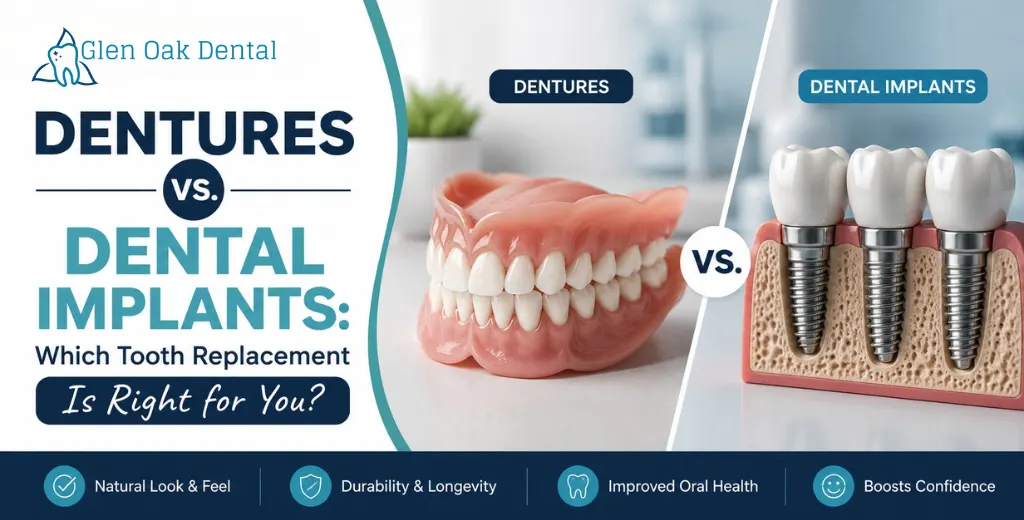
Dentures are removable artificial teeth that rest on top of your gum tissue, while dental implants are permanent titanium posts surgically anchored directly into your jawbone to act exactly like natural tooth roots. At Glen Oak Dental, we help patients in North York decide which option best fits their oral health and lifestyle.
Dentures vs. Dental Implants
Missing a tooth can feel overwhelming. Whether you lost a tooth to severe decay, a sports injury, or age-related complications, the gap left behind affects much more than just the appearance of your smile. It shifts how you speak, completely changes what you can comfortably eat, and can take a massive toll on your daily self-confidence.
Dentures are removable artificial teeth that rest on top of your gum tissue, while dental implants are permanent titanium posts surgically anchored directly into your jawbone to act exactly like natural tooth roots.
If you are currently looking into your replacement options, you have likely narrowed your search down to two main choices. What is the primary difference between dentures and dental implants? Simply put, dentures are removable artificial teeth that rest on top of your gum tissue, while dental implants are permanent titanium posts surgically anchored directly into your jawbone to act exactly like natural tooth roots.
As a dentist, I have this exact conversation with patients every single day in the clinic. There is no universal “best” choice—there is only the choice that is clinically and functionally best for you. Today, I want to walk you through the reality of both options. We will look at the science, the biological impact on your facial structure, and the daily realities of living with dentures vs. dental implants, so you can make a confident, highly informed decision about your long-term oral health.
The Hidden Impact of Tooth Loss on Jawbone Health
Losing a tooth causes jawbone resorption because the root no longer stimulates the bone, which can lead to a sunken facial appearance and shifting of neighbouring teeth over time.
Before we compare the solutions, we first need to understand the biological problem. When you lose a natural tooth, you lose the underlying root that stimulates your jawbone. According to clinical guidelines from the Canadian Dental Association (CDA), without that constant stimulation from chewing and biting, your jawbone begins a process called resorption. Essentially, the bone slowly begins to shrink.
Over time, this progressive bone loss alters your entire facial structure. It often leads to a sunken, collapsed, or prematurely aged appearance around the mouth and cheeks. Furthermore, the healthy teeth surrounding the new gap will naturally begin to drift and tilt into the empty space. This shifting throws off your bite alignment, which can lead to jaw pain, premature wear on your remaining enamel, and even further tooth loss down the road.
This is exactly why replacing a missing tooth is not just a cosmetic preference; it is a fundamental, medically necessary step in protecting your overall structural health.
Understanding Dentures: The Traditional Approach
Dentures are custom-made acrylic or porcelain prosthetics that closely mimic natural teeth and gums, available as complete dentures for a full arch or partial dentures that fill gaps around remaining natural teeth.
Dentures have been the go-to standard for tooth replacement for generations, and modern advancements have drastically improved how they look. They are custom-made acrylic or porcelain prosthetics designed to closely mimic the appearance of your natural teeth and gums.
Types of Dentures
Depending on your specific clinical needs, we generally look at two primary categories:
- Complete Dentures: We use these when all of your teeth in an upper or lower arch are missing. They rest directly on your gums and rely on natural suction—and sometimes over-the-counter dental adhesive—to stay firmly in place.
- Partial Dentures: If you still retain some healthy natural teeth, a partial denture fills the empty gaps. It usually utilizes discrete metal or acrylic clasps that hook onto your remaining teeth for stability.
The Clinical Advantages of Dentures
Why do so many people still choose dentures today? They offer several distinct, highly practical benefits:
- Non-Invasive Process: Getting traditional dentures does not require any surgery. If you have underlying health conditions that make surgical procedures risky, dentures offer a completely safe, reliable, and non-invasive alternative.
- Faster Restorative Timeline: While you still need precise impressions and multiple fitting appointments, the overall timeline to walk out of the clinic with a fully restored smile is generally much shorter than the implant healing process.
- Adaptable to Low Bone Density: If you have already suffered significant jawbone loss, traditional dentures can still be fitted securely without the need for complex bone grafting surgeries.
The Drawbacks and Limitations
I always want my patients to clearly understand the long-term realities of any treatment. Dentures have a few notable clinical and lifestyle downsides:
- Bone Loss Continues: Because dentures simply sit on top of the gums, they do not stimulate the underlying jawbone. Consequently, bone resorption will continue to progress over time.
- Fit Changes and Adjustments: As your jawbone inevitably shrinks, your previously perfectly fitted dentures will become loose. You will need to visit your dentist for regular relining (adjusting the acrylic base for a better fit) every few years.
- Decreased Chewing Force: Studies show that traditional dentures only restore about 20% to 25% of your natural bite force. You will need to actively avoid extremely hard, sticky, or tough foods (like steak, raw carrots, or whole apples), as these can easily dislodge or crack the acrylic prosthetic.
Understanding Dental Implants: The Modern Standard
Dental implants involve surgically placing a titanium post into the jawbone, allowing it to fuse with the bone through osseointegration before a custom crown is attached, resulting in a permanent tooth replacement.
Dental implants represent the closest thing we have in modern dental science to actually regrowing a natural tooth. They are highly engineered, permanent fixtures.
How the Implant Process Works
A single dental implant actually consists of three distinct parts. First, I surgically place a small, highly biocompatible titanium post directly into your jawbone. Over the next few months, an incredible biological process called osseointegration occurs. Your natural bone tissue literally grows around and fuses directly to the microscopic grooves of the titanium post.
Once the area is completely healed and structurally solid, we attach an abutment (a small connector piece). Finally, we secure a custom-milled porcelain crown to the abutment. This final crown looks, feels, and functions exactly like a real tooth.
The Clinical Advantages of Dental Implants
Implants are widely considered the gold standard for tooth replacement for very specific biological reasons:
- Jawbone Preservation: Because the titanium post acts as an artificial root, it actively stimulates the jawbone every single time you chew. This halts bone loss entirely and preserves your natural facial structure.
- Natural Feel and Unmatched Function: They do not slip, click, or fall out. Because they are anchored into the bone, implants restore near-100% of your natural chewing force. You can confidently eat your favourite hard or chewy foods without a second thought.
- Incredible Longevity: With excellent oral hygiene, the titanium implant post itself can easily last a lifetime. Clinical guidelines from health authorities highlight an implant success rate of over 95%.
The Drawbacks and Limitations
While they are a highly effective and permanent solution, implants are not suited for absolutely everyone:
- Surgical Requirement: The placement process requires minor oral surgery and a dedicated healing period that can take several months before the final tooth is attached.
- Strict Anatomy Requirements: You must have sufficient bone density and volume to safely hold the titanium implant. If you have suffered significant bone loss over the years, you might require a preliminary bone grafting procedure to rebuild the area before we can place the implant.
- Systemic Health Factors: Conditions that impede healing, such as uncontrolled diabetes or active smoking habits, can significantly increase the risk of implant failure.
The Core Comparison: Dentures vs. Dental Implants
Dental implants restore near-100% of natural chewing force and last a lifetime with proper care, while dentures restore only 20-25% of bite force and typically need replacement every 5 to 7 years.
To help you make the best decision, let’s put these two options head-to-head in the exact categories that impact your daily life the most.
1. Daily Maintenance and Oral Hygiene
Dentures: You must remove your complete or partial dentures every single night. You will brush them gently with a specialized, non-abrasive denture cleaner (regular toothpaste will scratch the acrylic) and soak them overnight in a solution to keep them sanitized and prevent the material from warping. You also need to gently brush your bare gums to stimulate blood flow.
Implants: You maintain your implants exactly like your natural teeth. You brush them twice a day, floss around them daily, and visit the clinic for your standard cleanings. There is no special overnight soaking, no sticky adhesives to clean off your gums, and absolutely no taking them out at night.
2. Comfort, Speech, and Chewing Force
Dentures: While modern dentures look incredibly natural, they take a physical adjustment period. You might experience excess saliva or minor speech changes (like a slight lisp) when you first start wearing them. Upper dentures cover the entire roof of your mouth, which can slightly dull your sense of taste and temperature sensitivity. Furthermore, because you only have about 25% of your natural bite force, you must chew slowly and evenly on both sides of your mouth.
Implants: They feel completely natural in the mouth. The roof of your mouth remains uncovered, preserving your full sense of taste. Your speech stays entirely clear, and you never have to worry about them slipping or clicking while you laugh or talk in social situations. You also regain your full natural bite force.
3. Treatment Timeline and Longevity
Dentures: The process to create a set of custom dentures usually takes a few weeks, involving several impression and fitting appointments. However, traditional dentures only last between 5 and 7 years on average. Because your jawbone continually changes shape, the hard acrylic will eventually lose its proper fit, requiring complete replacement.
Implants: The implant timeline is a longer journey. From the initial extraction to the final crown placement, the process can take anywhere from three to eight months, depending on your healing speed and whether you need bone grafting. However, once successfully integrated, the titanium implant post can stay securely in your jaw for the rest of your life.
How to Choose: Which Option Fits Your Life?
Choosing between dentures and implants depends on your budget, bone density, surgical eligibility, and whether you prioritize a faster timeline or long-term jawbone preservation.
When patients come into Glen Oak Dental for a consultation, we never push a one-size-fits-all solution. We sit down, review your 3D imaging, and look at the full picture of your health and lifestyle. Here is how I usually help patients frame their final decision:
You might lean toward Traditional Dentures if:
- You strongly prefer a non-surgical solution.
- You have significant, advanced jawbone loss and prefer to avoid invasive bone grafting procedures.
- You have systemic health issues (like uncontrolled diabetes, active cancer treatments, or severe autoimmune disorders) that safely preclude you from elective surgery.
- You want a faster restorative timeline to regain a full smile.
You might lean toward Dental Implants if:
- You want a permanent, incredibly stable “set it and forget it” solution.
- You want to actively preserve your jawbone and maintain your natural facial structure.
- You dislike the idea of removing your teeth at night or dealing with messy adhesives.
- You want to eat tough, crunchy, and sticky foods without hesitation or worry.
The Hybrid Solution: Implant-Supported Dentures
Implant-supported dentures, or All-on-4 overdentures, use two to six strategically placed titanium implants to permanently anchor a full arch of artificial teeth, combining implant stability with full-arch denture coverage.
It is important to know that a middle ground exists. Implant-supported dentures (often referred to as “All-on-4” or overdentures) use two to six strategically placed titanium implants to permanently anchor a full arch of artificial teeth. This gives you the incredible, slip-free stability and bone preservation of implants, with the broader, full-arch replacement scope of a denture. For many patients missing all their teeth, this is the ultimate life-changing compromise.
Frequently Asked Questions (FAQs)
Complete Dental Care: Related Services at Glen Oak Dental
Dentures and dental implants often overlap with other treatments as part of a complete tooth-replacement plan. At Glen Oak Dental, we also provide:
- Dental implants in North York — for permanently replacing missing teeth and preserving jawbone health.
- Dentures in North York — for patients needing a full or partial removable tooth replacement.
- Dental bridges in North York — a fixed, non-surgical alternative for replacing one or more consecutive missing teeth.
- Tooth extraction in North York — safe, gentle extractions with replacement planning discussed at your follow-up.
- Teeth cleaning in North York — regular professional cleanings that protect your implants and remaining natural teeth.
- Emergency dentistry in North York — for sudden pain, a broken tooth, or a lost crown.
Taking the Next Step Toward Your New Smile
Deciding between traditional dentures and permanent dental implants is a significant step, but it is also a highly exciting one. By researching your options, you are actively choosing to reclaim your daily comfort, your oral health, and your confidence to smile freely.
You do not have to make this monumental choice alone. The absolute best way to find out which tooth replacement option is right for your unique anatomy is to undergo a comprehensive clinical examination. Here at Glen Oak Dental, we will take detailed 3D CBCT scans of your jawbone, carefully discuss your long-term lifestyle goals, and build a highly personalized treatment plan that perfectly fits your clinical needs.
Do not let missing teeth hold you back from enjoying your life any longer. Reach out to schedule a consultation, and let’s get you back to smiling, speaking, and eating with total confidence.
Book Your Consultation in North York
Glen Oak Dental — 2827 Bathurst Street, North York, ON M6B 3A4
Phone: 416-551-8480 | glenoakdental.ca
Led by Dr. Roya Khoshsar, D.D.S. — 15+ years of clinical experience in North York
Dentures and dental implants under one roof | Accepting new patients of all ages | Direct insurance billing
Clinical Accuracy: The information within this article rigidly reflects current clinical dental guidelines and restorative best practices. Trusted Sources: Biological mechanics, bone resorption data, and prosthetic longevity statistics were carefully verified using established, peer-reviewed data from the American Dental Association (ADA), the Canadian Dental Association (CDA), and Health Canada.