
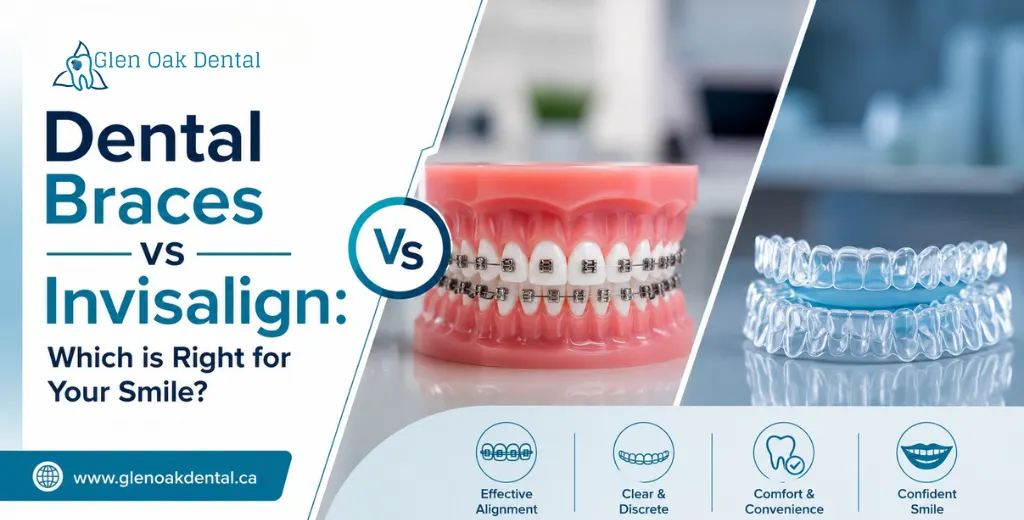
Choosing between dental braces and Invisalign depends on your bite complexity, lifestyle, and compliance habits. At Glen Oak Dental, led by Dr. Roya Khoshsar, D.D.S., we create personalized orthodontic treatment plans in North York that match your clinical needs and daily life. This 2026 guide covers every key difference so you can make a fully informed decision.
Dental Braces vs Invisalign:
Understanding Your Orthodontic Options at Glen Oak Dental North York
As a practicing dentist, one question comes up almost every single day: “Doc, which is better for me — braces or Invisalign?” It is a fantastic question, and asking it means you are taking your oral health seriously. Choosing the best teeth straightening option is a major step toward a healthier, more confident you. You naturally want a smile makeover that looks great, feels comfortable, and lasts a lifetime.
Today, modern teeth straightening options offer incredible flexibility and precision. Whether you are dealing with overcrowded teeth, spacing issues, or just a few crooked teeth, you have highly effective, scientifically proven choices. But deciding between traditional dental braces and Invisalign clear aligners requires understanding how each system interacts with your biology. This guide walks you through the exact differences, relying on clinical facts, logic, and zero fluff — so you can make an informed, confident choice.
- Traditional braces: Fixed appliances with brackets and archwires — ideal for complex bite correction and severe crowding.
- Invisalign clear aligners: Removable, nearly invisible trays — ideal for mild to moderate alignment issues in image-conscious adults and teens.
- Both methods: Use the same biological principle of gentle, continuous pressure to shift teeth safely through the jawbone.
- Post-treatment retention: Required regardless of which appliance you choose, to lock in your new smile permanently.
Understanding Your Options: The Biology of Tooth Movement
Both traditional braces and Invisalign clear aligners rely on the same biological principle — applying gentle, constant pressure to shift teeth gradually through the jawbone using a structure called the periodontal ligament.
Before comparing the specific appliances, it helps to understand what orthodontic treatment actually achieves. Orthodontic care goes far beyond facial aesthetics. The goal is optimal teeth positioning, correct jaw alignment, and complete bite correction. When your teeth align correctly, you experience improved bite function, easier brushing and flossing, and a significantly lower risk of long-term dental complications like uneven enamel wear or gum disease.
Your teeth sit in a hammock-like structure called the periodontal ligament. When we apply pressure using an orthodontic appliance, the body responds by safely remodelling the bone, allowing for gradual teeth movement. Whether you choose fixed braces or custom aligners, the end goal remains identical — a healthy smile supported by strong, functional mechanics.
The Power of Traditional Dental Braces
Traditional dental braces are fixed orthodontic appliances consisting of brackets bonded to the teeth and connected by an archwire. They deliver continuous, uninterrupted pressure 24 hours a day and excel at correcting complex bite problems, severe crowding, and significantly rotated teeth.
Today’s metal braces and ceramic braces are sleeker, highly efficient, and vastly more comfortable than older generations. Braces consist of small brackets bonded directly to the front of your teeth, connected by a specialized archwire. Because they remain permanently attached to your teeth 24/7 during your entire treatment, they deliver continuous, uninterrupted pressure.
Braces are frequently recommended for crowded teeth and severe malocclusion. They excel at handling complex dental conditions like a deep overbite, a severe underbite, a crossbite, or an open bite. If you have severely rotated teeth or teeth sitting far outside their ideal arch position, the sheer mechanical control of fixed braces is practically unmatched. Individual roots can be manipulated with pinpoint accuracy. Furthermore, because you cannot simply remove them, treatment compliance is guaranteed — you never have to worry about misplacing your appliance after a dinner party.
The Innovation of Invisalign Clear Aligners
Invisalign is the most recognized clear aligner system in the world. It uses a series of removable, custom-made thermoplastic trays planned digitally to move teeth gradually — offering a nearly invisible, highly comfortable alternative to traditional braces for mild to moderate alignment issues.
Invisalign uses a series of removable aligners crafted from highly engineered, medical-grade thermoplastic materials. The clear aligner treatment process begins with high-tech digital smile planning. Using a precise 3D intraoral scanner, we map your entire mouth and project the exact tooth movement required from day one to completion. You then receive a series of customized aligner trays, usually changed out every one to two weeks at home. Each new aligner tray brings you slightly closer to your final dental alignment.
Invisalign is generally suggested for mild to moderate alignment issues, such as minor gaps between teeth, mild spacing issues, or slightly uneven teeth. The biggest appeal is that these nearly invisible aligners offer a remarkably comfortable orthodontic solution — you can take them out to eat, brush, and floss. However, that removability comes with a major clinical caveat: you must wear them for 20 to 22 hours every day to achieve predictable tooth movement.
Dental Braces vs Invisalign: A Direct Comparison
Comparing braces and Invisalign across aesthetics, comfort, oral hygiene, clinical effectiveness, and treatment time reveals that the best choice depends entirely on your bite complexity, lifestyle habits, and personal preferences.
Now that we understand the foundational mechanics, let us look at the braces or Invisalign debate across a few vital lifestyle and clinical categories. This head-to-head breakdown will clarify who should get braces and who is a candidate for Invisalign.
1. Aesthetic Appeal and Visibility
Invisalign’s transparent trays are nearly invisible and blend seamlessly with natural teeth, making them the clear winner for patients who prioritize discretion. Modern ceramic braces offer a tooth-coloured middle ground, but Invisalign remains the most discreet orthodontic option available.
If you prioritize discretion, Invisalign is the clear winner. The transparent trays blend seamlessly with your natural teeth, making them an incredible clear braces alternative. You can attend board meetings, take family photos, and socialize without anyone noticing you are undergoing orthodontic treatment.
However, do not discount modern fixed braces. While metal braces remain visible, modern ceramic braces offer a fantastic aesthetic middle ground. The brackets use tooth-coloured composite materials that blend in beautifully with your natural enamel, offering a much softer look. Still, for absolute stealth, Invisalign compared to braces wins the aesthetic category decisively.
2. Comfort and Daily Routine
Invisalign generally provides more comfortable daily wear than braces because the smooth plastic trays eliminate the risk of wires or brackets irritating soft tissue. Both options cause mild tenderness after adjustments or tray changes, which is a normal sign that teeth are moving.
Moving teeth safely involves applying pressure, so neither option is entirely painless. When you first get braces applied, or when you switch to a tight new aligner tray, you will feel some mild tenderness. This is completely normal — it means the biology is working. Invisalign generally provides a more comfortable orthodontic solution overall. The aligner trays consist of smooth plastic, eliminating the risk of wires poking your cheeks or metal brackets irritating your lips.
Your lifestyle heavily dictates the best teeth straightening option for you. With fixed braces, you must avoid sticky, hard, or chewy foods — like caramel, tough nuts, and popcorn — to prevent breaking a bracket. With a removable orthodontic appliance, you simply pop the trays out before a meal, meaning zero food restrictions and a much more enjoyable daily culinary life.
3. Keeping Your Smile Clean: Oral Hygiene
Invisalign offers a significant oral hygiene advantage because the removable trays allow normal brushing and flossing routines. Traditional braces require special tools like threader floss and interdental brushes to clean effectively around brackets and wires.
Excellent oral hygiene during your treatment is mandatory. Moving teeth while leaving plaque and bacteria behind is a guaranteed recipe for cavities, decalcification (white spots), and gum disease. Invisalign takes the crown here — because you remove the trays, you enjoy vastly easier brushing and flossing and can perform your standard morning and evening routines without navigating around wires and brackets.
Fixed braces require real dedication. You will need special tools, such as threader floss, interdental brushes, or water flossers, to clean effectively between the brackets. Maintaining a brilliantly healthy smile with braces is entirely possible if you commit to the routine.
4. Correcting Complex Dental Conditions
Traditional braces hold the structural advantage for severe orthodontic conditions, including severe crowding, impacted teeth, and major bite alignment issues. Invisalign is fast and precise for mild to moderate alignment problems but may not achieve the same level of root control as fixed brackets in complex cases.
Clinical effectiveness depends entirely on your specific bite problems. For mild spacing issues, slight crowding, or a minor relapse after previous orthodontic care, Invisalign for teeth alignment is fast, precise, and predictable. But if you present with severe teeth crowding, an impacted tooth, or a massive bite alignment issue, traditional braces are the heavy lifters. Braces for bite correction offer your dental professional the ultimate granular control — we can guide teeth into complex vertical positions that clear aligners sometimes struggle to achieve on their own.
5. Treatment Time and Speed
For mild to moderate cases, Invisalign can complete treatment in 6 to 12 months due to optimized digital planning. For moderate to severe conditions, both braces and Invisalign typically share similar timelines of 12 to 24 months. Compliance with aligner wear directly determines how quickly treatment progresses.
Patients always ask, “Which one is faster?” The honest clinical answer is: it depends on your biology and your compliance. For straightforward, mild corrections, clear aligners can sometimes finish the job in 6 to 12 months, simply because the digital planning optimizes every single micro-movement. However, for moderate to severe cases, braces and Invisalign often share similar timelines, generally ranging from 12 to 24 months. What truly dictates the speed of aligner treatment is treatment compliance — if you leave your aligners out for hours at a time, your treatment will undoubtedly stall.
Who Should Get Braces?
Traditional braces are the best choice for patients with severe bite problems, significantly rotated or crowded teeth, or those who struggle with maintaining consistent daily habits with a removable appliance.
Based on our clinical guidelines, you are an excellent candidate for traditional braces if:
- You have severe bite problems, such as a major overbite or underbite.
- You have severely rotated teeth or significant teeth crowding.
- You prefer an appliance that works passively 24/7 without you having to remember to wear it.
- You struggle with building new habits and know you might forget to wear removable trays.
Who Is a Candidate for Invisalign?
Invisalign is best suited for patients with mild to moderate alignment issues who are highly disciplined about consistent wear, want a discreet treatment, and prefer the freedom to eat without dietary restrictions.
You will likely thrive with Invisalign clear aligners if:
- You have mild to moderate misaligned teeth or minor gaps between teeth.
- You require a highly discreet orthodontic treatment for professional or social reasons.
- You are highly disciplined and can commit to 22 hours of daily wear.
- You want the freedom to eat whatever you like without food restrictions.
- You want to maintain a simple, unobstructed oral hygiene routine.
Age Considerations: Teens vs Adults
Age is a key factor in orthodontic planning. Teens often do well with either option, but parents must honestly assess their teen’s discipline before choosing removable aligners. Adults — especially working professionals — often prefer Invisalign for its discreet appearance, and healthy teeth can be moved safely at any age.
Age plays a vital role when planning a smile transformation. Teeth straightening for teens usually involves managing active jaw growth simultaneously. Teens often adapt wonderfully to either option. However, parents must honestly assess their teenager’s responsibility level before choosing removable aligners vs fixed braces — if a teen constantly misplaces their phone or keys, fixed braces are the safer, more predictable route.
Meanwhile, adult bone is denser, meaning teeth shift a little more slowly. The best orthodontic treatment for adults often leans heavily toward Invisalign, simply because working professionals prefer the discreet aesthetic. Orthodontic treatment for adults has surged in popularity over the last decade, proving that it is never too late to invest in facial aesthetics and structural oral health.
The Long-Term Goal: Post-Treatment Retention
Regardless of whether you choose braces or Invisalign, wearing post-treatment retainers is clinically necessary to hold your new smile in place while the surrounding bone solidifies. Without retainers, teeth will drift back to their original positions over time.
No matter which modern teeth straightening option you choose, the day your active treatment ends is not the final step. Teeth have a strong “memory” anchored in the periodontal ligament, and they desperately want to drift back to their old, misaligned positions. Whether you choose braces or Invisalign, you will unequivocally need dental retainers to lock your new smile in place while the surrounding bone solidifies. Long-term orthodontic care involves wearing these retainers exactly as prescribed — usually every night for a lifetime. At Glen Oak Dental, we closely monitor our patients during orthodontic follow-up visits to ensure their teeth positioning remains perfectly stable for decades.
Making the Right Choice at Glen Oak Dental North York
So, which is right for your unique smile? You cannot make this crucial decision by reading a blog article alone — you need a professional, hands-on orthodontic assessment. At Glen Oak Dental, we believe in creating a highly personalized treatment plan for every single patient. When you come in for an orthodontic consultation, we conduct a comprehensive dental examination. We capture highly accurate digital scans, analyze your jaw structure, evaluate your gum health, and discuss your daily lifestyle habits. We take a holistic look at the clinical reality of your mouth.
Do you have a severe crossbite requiring heavy, sustained forces? We will confidently lean toward braces. Do you have minor gaps and a busy, client-facing professional life? We will explore Invisalign. We never push a generic, one-size-fits-all approach — instead, we use trusted diagnostics to guide you toward the safest, most effective smile improvement options available.
What the ADA, CDA, and Health Canada Say About Orthodontic Treatment
Major dental and health authorities support both braces and clear aligners as clinically effective orthodontic solutions when properly indicated. Their guidance emphasises that the best treatment depends on clinical diagnosis, not patient preference alone.
American Dental Association — Evidence-Based Orthodontic Standards
The American Dental Association (ADA) recognizes both fixed orthodontic appliances and clear aligner systems as clinically valid treatments when properly selected based on patient diagnosis. The ADA emphasises that orthodontic treatment, regardless of appliance type, must be preceded by a comprehensive clinical examination — including radiographic analysis — to determine the most appropriate course of care. The ADA also highlights the importance of post-treatment retention in preventing orthodontic relapse.
Canadian Dental Association — Patient-Centred Orthodontic Care
The Canadian Dental Association (CDA) supports a patient-centred, evidence-based approach to orthodontic treatment selection. CDA guidelines emphasise that both braces and clear aligners are appropriate tools when matched to the patient’s clinical needs, compliance profile, and treatment goals. The CDA also reinforces that gum health must be assessed and maintained throughout orthodontic treatment, since inflamed or compromised gum tissue can impair tooth movement and increase the risk of periodontal disease.
Health Canada — Safety and Regulation of Orthodontic Devices
Health Canada regulates all orthodontic materials — including the medical-grade thermoplastic used in clear aligners and the metals used in traditional bracket systems — under the Medical Devices Regulations. All appliances and materials used at licensed Canadian dental clinics are reviewed and approved by Health Canada for safety and biocompatibility. This ensures that every patient undergoing orthodontic treatment in Canada receives care using materials that meet the country’s highest regulatory standards.
From Practice: What We See at Glen Oak Dental
In orthodontic practice, one of the most common patterns is that patients come in convinced they need one treatment, only to discover after a thorough clinical examination that the other option is a far better fit. A patient who insists on Invisalign for lifestyle reasons may have bite complexity that genuinely requires the precision of fixed braces — and beginning with the wrong appliance wastes both time and money.
A second common case involves teens who are given clear aligners but struggle with the required 22 hours of daily wear. In these situations, compliance issues cause treatment stalls, and a switch to fixed braces often produces faster, more predictable results. Understanding your own habits and lifestyle honestly is just as important as understanding your clinical diagnosis.
Expert Insight on Orthodontic Treatment Selection
Choosing between braces and Invisalign is not simply a matter of preference — it is a clinical decision that must be grounded in a thorough examination of your teeth, bite, bone structure, and gum health. The most effective orthodontic treatment is always the one that matches your specific diagnosis, not just the one that looks most appealing on social media.
The best approach is to consult a dental professional before forming strong opinions about which appliance you want. A treatment that is perfect for your colleague or sibling may be completely inappropriate for your clinical situation. At Glen Oak Dental, we take pride in giving every patient an honest, transparent assessment — not just the answer they want to hear.
Why Orthodontic Treatment Matters in Canada
For Canadian patients, orthodontic care is not only about aesthetics — properly aligned teeth are easier to clean, reducing the long-term risk of cavities, gum disease, and bone loss. Investing in the right orthodontic treatment early can prevent far more costly dental problems later in life.
Regular orthodontic monitoring, combined with consistent professional teeth cleanings, protects both teeth and supporting tissues throughout treatment and beyond. This is especially important for patients with a history of gum problems, as orthodontic treatment can be more complex when gum health is compromised.
Families should also recognize that orthodontic planning for children and teens is often more effective when started during active jaw growth. Early monitoring ensures that orthodontic needs are identified and addressed at the right time for the best possible outcomes.
Complete Orthodontic Care: How Braces and Invisalign Fit Into Your Dental Plan
Straight, properly aligned teeth provide the foundation for every other aspect of your oral health. At Glen Oak Dental, we offer a full range of supporting services that work alongside orthodontic treatment:
- Invisalign and orthodontic treatment in North York — personalized clear aligner therapy for mild to moderate alignment correction.
- Professional teeth cleaning in North York — essential for maintaining gum health and preventing plaque buildup during orthodontic treatment.
- Children’s and family dentistry in North York — early orthodontic monitoring and age-appropriate care for patients of all ages.
- Emergency dentistry in North York — same-day care for broken brackets, poking wires, or orthodontic-related discomfort.
- Root canal therapy in North York — when tooth infections must be treated before or during orthodontic care.
- Tooth implants in North York — replacing missing teeth that must be addressed before final orthodontic positioning.
- Dental bridges in North York — restoring missing teeth when implants are not the preferred option post-orthodontics.
- Dentures in North York — comprehensive tooth replacement for patients requiring full mouth rehabilitation alongside orthodontic planning.
- Cosmetic dentistry in North York — smile enhancement services to complete your transformation after orthodontic treatment.
- Teeth whitening in North York — brighten your newly aligned smile once orthodontic treatment is stable and complete.
- Tooth extraction in North York — creating space for proper alignment when teeth are too crowded for movement alone.
Conclusion
Dental braces and Invisalign are both highly effective, scientifically validated orthodontic solutions — but they are not interchangeable. Traditional braces offer unmatched mechanical control for complex bite correction and severe crowding. Invisalign excels at delivering discreet, comfortable treatment for mild to moderate alignment issues in patients who can commit to consistent daily wear. The right choice is not about which option looks better online — it is about which appliance matches your unique clinical diagnosis, lifestyle, and long-term oral health goals.
Whether you are a teen, an adult professional, or a parent researching options for your child, the best first step is a comprehensive orthodontic consultation. At Glen Oak Dental, we are here to give you an honest, evidence-based assessment and a treatment plan built entirely around your needs.
Frequently Asked Questions About Braces vs Invisalign
Ready to Start Your Smile Transformation in North York?
A straighter, healthier smile is one of the most valuable investments you can make in your long-term oral health and confidence. Whether you are leaning toward traditional braces or Invisalign, the best next step is a professional consultation with a dental team you can trust.
Book Your Orthodontic Consultation in North York
Glen Oak Dental — 2827 Bathurst Street, North York, ON M6B 3A4
Phone: 416-551-8480 | glenoakdental.ca
Led by Dr. Roya Khoshsar, D.D.S. — 15+ years of clinical experience in North York
Braces & Invisalign consultations available | Accepting new patients of all ages | Direct insurance billing
Whether you need a personalized Invisalign plan, require emergency dental care for a broken bracket, or want to complete your smile with cosmetic dentistry after orthodontic treatment — our team delivers honest, transparent guidance at every step.
This guide was carefully developed to provide accurate, highly readable, and trustworthy information about dental braces, Invisalign, and orthodontic treatment in North York. The content is directly based on established clinical dental guidelines and has been cross-referenced with trusted medical sources including official recommendations from the American Dental Association (ADA), the Canadian Dental Association (CDA), and Health Canada. The clinical information reflects current 2026 orthodontic standards and has been structured according to SEO, AEO (Answer Engine Optimization), and GEO (Generative Engine Optimization) best practices.