
Dr. Roya Khoshsar, D.D.S. | General, Cosmetic & Restorative Dentist, Glen Oak Dental, North York
15+ years of clinical experience | Follows Canadian Dental Association (CDA) guidelines
Invisalign uses clear, removable aligners custom-designed for your smile, while traditional braces use fixed brackets and wires for continuous tooth movement. Both are effective orthodontic treatments offered at Glen Oak Dental in North York. The right choice depends on your dental condition, lifestyle, and goals. According to the Canadian Dental Association (CDA), both treatments are clinically proven and safe for adults and teens.
Introduction
If you are considering straightening your teeth, you have likely searched for information on Invisalign vs braces. It is one of the most important decisions in your smile journey — and choosing the right option can impact your comfort, confidence, and long-term results.
At Glen Oak Dental, located at 2827 Bathurst Street in North York, Dr. Roya Khoshsar and the team regularly help patients choose between Invisalign and traditional braces. This guide gives you clear, evidence-based answers — so you can make the best choice with confidence. The Canadian Dental Association (CDA) and American Dental Association (ADA) both recognise orthodontic treatment as essential to long-term oral health.
What Is the Difference Between Invisalign and Braces?
Invisalign vs braces is a comparison between two highly effective orthodontic solutions used to straighten teeth and improve bite alignment.
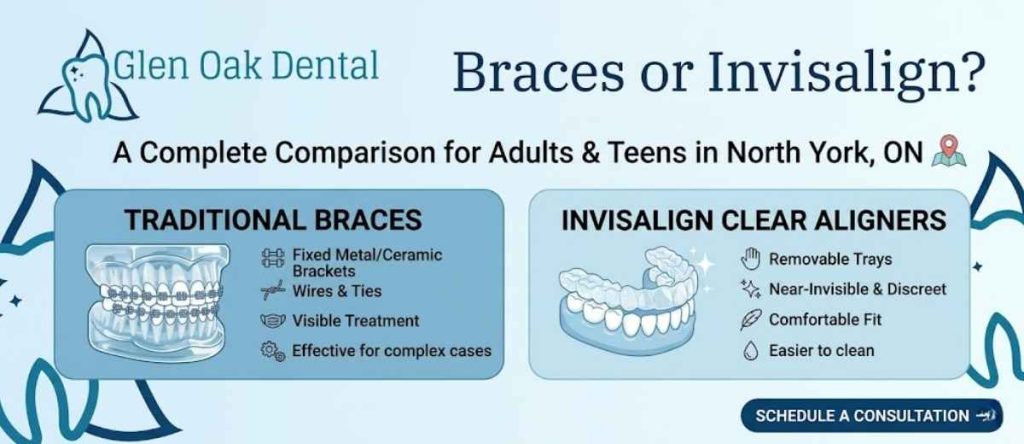
- Traditional braces use fixed metal or ceramic brackets bonded to teeth, connected by wires that gradually move teeth into position
- Invisalign clear aligners are custom-made, removable trays that gently shift teeth over time without metal hardware
Both treatments deliver excellent results — but they differ in appearance, comfort, flexibility, and the types of cases they treat best. Health Canada regulates both orthodontic systems as medical devices, ensuring they meet strict safety and efficacy standards.
Invisalign vs Braces: Key Differences That Matter
| Feature | Traditional Braces | Invisalign |
|---|---|---|
| Visibility | Noticeable | Nearly invisible |
| Comfort | May cause wire/bracket irritation | Smooth and comfortable |
| Removability | Fixed — cannot be removed | Removable for eating and cleaning |
| Eating | Food restrictions apply | No restrictions |
| Oral Hygiene | More effort required | Easy brushing and flossing |
| Best For | Complex cases | Mild to moderate cases |
| Dental Visits | Regular wire adjustments needed | Fewer in-office visits required |
Your decision should be based on both your dental condition and your daily lifestyle. A consultation at Glen Oak Dental is the most reliable way to determine which option is right for you.
Is Invisalign Faster Than Braces?
A key question many patients ask is: is Invisalign faster than braces?
- Invisalign: 6–18 months (mild to moderate cases)
- Traditional braces: 18–24 months (moderate to complex cases)
Invisalign can be faster — but only if aligners are worn consistently for 20–22 hours per day. The Canadian Dental Association emphasises that patient compliance is the single biggest factor in orthodontic treatment outcomes.
At Glen Oak Dental, our team closely monitors your progress to ensure your treatment stays on track and delivers results as efficiently as possible. Before starting Invisalign treatment, maintaining good oral hygiene through regular professional cleanings helps create the best possible foundation.
Cost of Invisalign vs Braces in North York, Ontario
The cost of orthodontic treatment varies depending on your individual case. Every patient’s dental needs are different — and so is the investment required to achieve the best result. Rather than publishing a fixed price, we believe in providing you with a transparent, personalised estimate based on your specific situation.
What impacts the cost?
Several factors influence your final treatment cost. Specifically, the following play the biggest role:
- Complexity of your case and number of aligners or adjustments required
- Length of treatment
- Technology and materials used
- Experience of your dental provider
Insurance and payment options
Glen Oak Dental direct-bills Sun Life, Manulife, Great-West Life, Equitable Life, and most other major Canadian insurance providers. Most dental plans include orthodontic benefits that partially cover both braces and Invisalign. We offer flexible monthly payment plans and transparent pricing with no hidden fees.
Get a personalised cost estimate
Treatment costs depend on your unique dental needs. Contact us to book a consultation and receive a transparent, itemised quote before anything begins — no pressure, no surprises.
Invisalign vs Braces for Adults in North York
Adults often prioritise discretion and flexibility when choosing orthodontic treatment. The American Dental Association (ADA) notes that orthodontic treatment is increasingly common among adults, with clear aligner systems driving much of this growth.
Why adults choose Invisalign
- Nearly invisible aligners that do not impact professional appearance
- Removable for meals, presentations, and social events
- Easy oral hygiene — brush and floss normally
- Comfortable smooth plastic with no bracket irritation
However, braces may still be recommended for adults with severe crowding, complex bite alignment issues, or cases requiring more precise tooth movement. Our cosmetic dentistry team at Glen Oak Dental can also explore complementary treatments — such as professional teeth whitening — to complete your smile transformation after orthodontic treatment.
If you are considering Invisalign treatment in North York, a consultation at Glen Oak Dental will help determine the best option for your specific needs.
Invisalign vs Braces for Teens
Teens can benefit from both treatments, but the choice depends on dental complexity and personal responsibility. The Canadian Dental Association recommends an orthodontic assessment by age 7 to identify issues early — though treatment typically begins in the early teen years.
Braces for teens
- Always working — no compliance required
- Ideal for complex orthodontic issues
- No risk of misplacing the appliance
Invisalign for teens
- Clear and confidence-friendly — no visible metal
- Comfortable for school, sports, and social activities
- Designed with built-in compliance indicators
For families looking for orthodontic solutions in North York, our family and children’s dentistry team will assess your teen’s dental development and recommend the most effective treatment path. Good orthodontic outcomes also depend on a healthy foundation — our professional teeth cleaning service ensures your teen’s teeth and gums are in the best possible condition before treatment begins.
Lifestyle and Comfort Comparison
Your daily experience plays a major role in your decision.
Living with braces
- Soreness after each wire adjustment appointment
- Food restrictions — avoid sticky, hard, or chewy foods
- More effort required for brushing and flossing around brackets
- Regular professional cleanings are especially important to prevent decay under wires
Living with Invisalign
- Smooth, comfortable aligners with no wire irritation
- Remove aligners to eat whatever you like
- Easy brushing and flossing — simply remove the trays
- Fewer dental appointments required throughout treatment
If a dental emergency arises during orthodontic treatment — such as a loose bracket, broken wire, or sudden pain — our emergency dentist in North York offers same-day appointments to get you back on track quickly.
Pros and Cons of Invisalign
Pros
- Nearly invisible — ideal for professional and social settings
- Comfortable smooth plastic with no bracket or wire irritation
- Removable for complete flexibility with food and oral hygiene
- Fewer in-office visits compared to traditional braces
Cons
- Requires strong discipline — must be worn 20–22 hours daily
- Not suitable for severe or highly complex orthodontic cases
- Aligners can be misplaced if not stored carefully
Pros and Cons of Traditional Braces
Pros
- Effective for all cases — including complex bite and alignment corrections
- No compliance required — they work continuously, 24/7
- Precise, controlled tooth movement managed by your dentist
Cons
- Visible metal hardware may affect confidence
- Food restrictions throughout treatment
- More effort for oral hygiene — increased risk of decay around brackets without proper cleaning
How to Choose Between Invisalign vs Braces
Choose Invisalign if you:
- Want a discreet, modern solution with no visible hardware
- Have mild to moderate alignment or spacing issues
- Prefer flexibility in your routine and diet
- Are a busy professional or adult who values fewer clinic visits
Choose braces if you:
- Have complex orthodontic concerns — including significant bite misalignment
- Want a fixed, low-maintenance option that does not rely on daily compliance
- Are a teen who may not consistently wear removable aligners
The best treatment is the one that fits your lifestyle and delivers the results you need. At Glen Oak Dental, we build a personalised treatment plan based on your dental assessment, not a one-size-fits-all recommendation. Following orthodontic treatment, many patients also benefit from professional teeth whitening and our full range of cosmetic dentistry services to complete their smile.
Common Questions About Invisalign vs Braces — Answered
Below are the most common questions our North York patients ask. If you do not find your answer here, contact our team directly.
Conclusion
Both Invisalign and traditional braces are proven, effective orthodontic treatments. The right choice depends on the complexity of your case, your lifestyle, and your personal goals. Invisalign offers unmatched discretion and flexibility for mild to moderate cases, while braces deliver precise, reliable results for complex corrections without requiring daily compliance.
Whether you are an adult looking for a discreet solution, a parent exploring options for your teen, or simply ready to start your smile journey, the best first step is a professional consultation. At Glen Oak Dental in North York, Dr. Roya Khoshsar will assess your teeth, discuss your goals, and recommend the treatment best suited to your needs — with transparent pricing and no pressure. For complete family care, our family and children’s dentistry services ensure every member of your household is cared for under one roof.
Book an Invisalign or Braces Consultation at Glen Oak Dental
Glen Oak Dental — 2827 Bathurst Street, North York, ON M6B 3A4
Phone: 416-551-8480 | Website: glenoakdental.ca
Led by Dr. Roya Khoshsar, D.D.S. — 15+ years of experience in North York
Minutes from Lawrence West TTC Station. Parking available on-site. Now accepting new patients.
Glen Oak Dental follows all clinical guidelines of the Canadian Dental Association (CDA). All treatment recommendations are based on evidence-based practice and individual patient assessment. For national oral health guidance, visit Health Canada’s Oral Health resources.